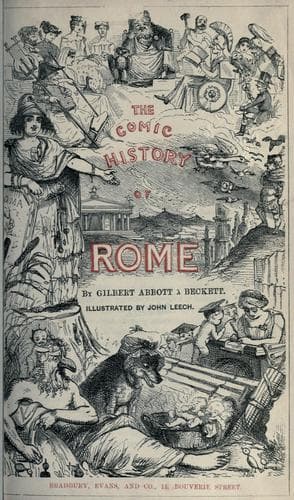
The Comic History of RomeÀ Beckett, Gilbert Abbott
History
The Comic History of Rome
À Beckett, Gilbert Abbott
Rome -- History -- Humor; Wit and humor, Pictorial
He was the son of a respectable Sabine farmer, and passed his earliest
years in the country, where he followed the plough--a peaceful pursuit,
which imprints no early furrows on the forehead, but leaves many on the
earth it at once improves and lacerates. At seventeen, every Roman
became, of necessity, a soldier; and though in the game of life fortune
had dealt him a spade, he was obliged to throw it out of his hand. Such
was the lot of young Marcus Porcius Priscus; for that was in reality his
name, though he afterwards had the title of Cato, or the "knowing one,"
bestowed on him. His military duties were performed with credit, though
he preferred cultivating any other seeds than the seeds of dissension;
and he was more at home in a trench dug for celery, than in one designed
for undermining a fort.
After returning from the wars, he took some ground adjoining that which
had been occupied by Dentatus; and regarding that individual as a model
farmer, Cato tried to make his own a model farm. So thoroughly did he
throw himself into his agrarian occupation, that he may be said to have
buried himself in his land. He wrote a work on Agriculture,[58] which
included much miscellaneous information, from the mode of buying an
estate to the art of making a cheesecake, the curing of a side of bacon,
and the setting of a dislocated bone. While attending to his own
business, he found leisure to attend to that of his neighbours; and in
all their petty disputes before the local tribunals, he was in the habit
of attending the hearing of summonses for and against his friends. He
had a word of advice or a maxim to meet every circumstance in which his
advice was asked or offered; and he could always cut through a
difficulty with one of his wise saws. Some might be disposed to term him
a busybody and a meddler; but at all events a young patrician, named
Valerius Flaccus, considered him to be a meddler well worth
transplanting, and persuaded him to go to Rome, "as," in the language of
Plutarch, "a plant that deserved a better soil." Here he "put up" for
various places in the public service, and we find him climbing
successively to several very high posts, where the example he set by his
externally virtuous mode of living, formed a decent contrast to the
undisguised vices of the age.
Public-domain text, read in full here on John Shaqi.
Reviews
Reviews
No reviews yet
Be the first to share your thoughts on this work.
Elsewhere in the archive
Join the Discussion
Join the discussion
Sign in to leave a comment or review.
Sign InorCreate an account