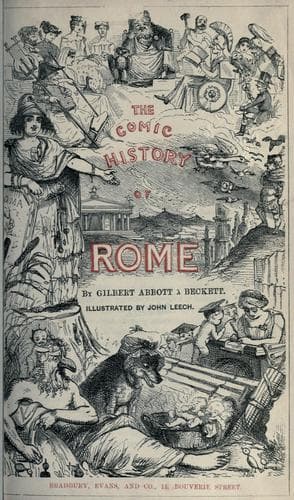
The Comic History of RomeÀ Beckett, Gilbert Abbott
History
The Comic History of Rome
À Beckett, Gilbert Abbott
Rome -- History -- Humor; Wit and humor, Pictorial
Such was Cato in his earlier years; but the melancholy fact must be
stated, that, though flattery paints only one side of every picture,
there is none to which truth may not be called upon to add a reverse. In
his youthful days Cato had worked with his labourers; had partaken of
the same fare with them at the same board, and drank nothing stronger
than water; but, in after-life, he contracted a disreputable marriage,
and, giving himself up to the dissipations of the table, might have
found himself occasionally under it. So thoroughly utilitarian was he in
his political philosophy, that he looked upon a labourer as a mere
machine, which, when worn out, he contended ought to be got rid of as
speedily as possible. Cato the Censor owes much of his reputation for
morality to the fact of his having set himself up as a professional
moralist. Though he was useful as a castigator of the vices of his age,
there was nothing very amiable in the rancorous and uncharitable spirit
in which he performed his office. He had a keen appetite for an abuse or
a piece of scandal, but, while crime or error excited his hatred, virtue
and generosity seemed to rouse less of his admiration than his jealousy.
If he had lived in modern times, he would, probably, have been a common
informer, a rigid observer of all the outward appearances of virtue, and
a discounter of bills; for it is said of Cato, that he advanced money at
exorbitant interest to those whose necessities or recklessness induced
them to comply with his terms.
Religion had, at about this period, sunk to a very low ebb in the hands
of a crafty priesthood, who used the influence of their position for
their own temporal purposes. Prodigies were declared to have happened;
such as the talking of a cow, which was alleged to have "whispered low"
in a priest's ear; statues were said to have wept; and the tale was
listened to by those who believed that their augurs could, if they
pleased, get blood out of a stone.
In literature, though it is customary to speak of Roman characters as an
original form of letters, Rome had nothing new, but trusted to what was
already known; for she not only copied the vices of the Greeks, but took
a leaf out of their books in a more literal manner. She had no writers
of her own; but what literary food she possessed was supplied by those
translating cooks who make a hash of nearly everything they lay their
hands upon.
Public-domain text, read in full here on John Shaqi.
Reviews
Reviews
No reviews yet
Be the first to share your thoughts on this work.
Elsewhere in the archive
Join the Discussion
Join the discussion
Sign in to leave a comment or review.
Sign InorCreate an account