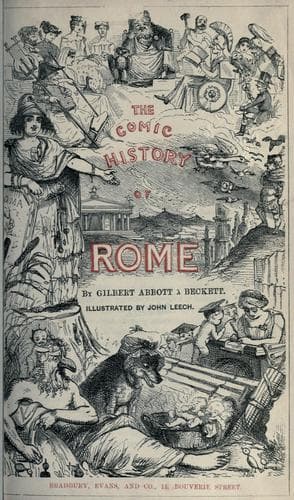
The Comic History of RomeÀ Beckett, Gilbert Abbott
History
The Comic History of Rome
À Beckett, Gilbert Abbott
Rome -- History -- Humor; Wit and humor, Pictorial
We might enumerate a long list of different masks, without introducing
any variety, for they were very nearly the same; but we have shown
enough to prove that the classical taste for which so many clamour
without knowing what they talk about, was very little, if at all, above
the modern standard. Some authorities[61] assert that masks were not
worn in the earliest representations of the Roman drama; but some of the
oldest MS. of Terence contain figures of the required masks, just as a
play of the present day has prefixed to it a list of the costumes of the
characters. The admirers of the classical may be grieved and astonished
to hear that the taste, for the restoration of which they so much pine,
took greater delight in the deadly games of the Circus, than in the
lively representations of men and manners.
[Illustration: Light Comedy Man of the Period.]
Historical literature was in a very humble condition, and had much, or
indeed all, the prolixity, with little of the accuracy, of a modern
report for a newspaper. It is, however, hardly fair to judge the authors
severely for writings which we have never seen, and are never likely to
see; for they have never come down to us, except in scraps--the result
of the various cuttings-up they have encountered at the hands of
Polybius and other critics. For the same reason, we are unable to praise
conscientiously the "Origines" of Cato, which has long ago been lost,
and we are unwilling to adopt the "opinions of the press," which have
too often been at the disposal of the member of a clique, or of the
purchaser of a puffing paragraph. Oratory always was, and always will
be, an important art, except in those countries which are so excessively
republican and free, that the people are free for every imaginable or
imaginary purpose, except to do as they please, and to say what they
think proper. The Romans took the art of rhetoric from the Greeks, but
even a good thing is distasteful if forced where it is not asked; and,
when the Athenians sent three professed orators as propagandists of
their art to Rome, the foreign agitators were ordered--very properly--to
quit the city.
As lawyers, the early Romans are entitled to high praise, and they
evinced their prudence by making juris-prudence an essential part of
their ordinary studies. The Roman youth were required to get the Twelve
Tables by heart, or rather, by head, which was supposed to be
sufficiently furnished when the whole of the Twelve Tables alluded to
were crammed into it.
Public-domain text, read in full here on John Shaqi.
Reviews
Reviews
No reviews yet
Be the first to share your thoughts on this work.
Elsewhere in the archive
Join the Discussion
Join the discussion
Sign in to leave a comment or review.
Sign InorCreate an account