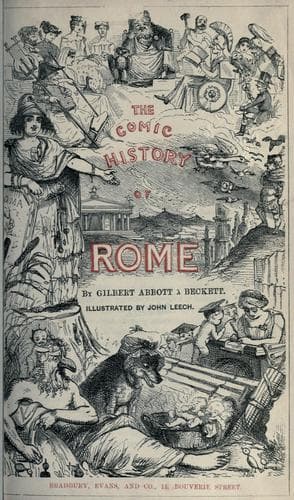
The Comic History of RomeÀ Beckett, Gilbert Abbott
History
The Comic History of Rome
À Beckett, Gilbert Abbott
Rome -- History -- Humor; Wit and humor, Pictorial
The science of Medicine was not in very high repute among the early
Romans, and physic was, commercially speaking, in very little demand, so
that it would have been a mere drug if brought into the market. The
aristocratic families generally expected one of their slaves to know
something of the healing process, as they usually did of other arts or
trades; and a surgical operation, like a gardening operation, or any
piece of merely manual labour, was frequently entrusted to the hands of
a simple bondsman. Physic was scarcely known in Rome as a distinct
pursuit, until the year of the City 534 (B.C. 219), when the Greek
physician Archagathus opened a shop with an extensive stock, and an
establishment of baths; the expense of which would have plunged him into
hot water, had not the public come forward to make him a present of his
premises. The shops of the doctors were lounging places for the idle,
who are always the most profitable patients; for there is no ailing so
troublesome as that of having nothing to do, and abundance of time to do
it in. The Romans had made little advance in art, though they professed
to show their love for it by robbing other nations of their treasures.
On the same principle, the pickpocket, who pilfers a handkerchief, might
ask credit for being attracted by the beauty of its design; and the
knave who walks away with a set of silver spoons might pretend to be
actuated by a desire to patronise their pattern or their workmanship.
Rome, indeed, can scarcely be said to have introduced the arts from
Greece, but merely to have introduced a few of the articles on which the
arts had employed themselves.
Commerce was looked down upon for a long period as a degrading pursuit;
but from the time of the Second Punic War, the equites, with a total
disregard of equity, began lending out money at exorbitant interest.
Though they would not condescend to trade for gain, they were prepared
to pocket the profits of usury. They would also purchase corn at a low
price abroad, and sell it at a dear rate at home; for they understood
and practised all the tricks of the tradesman, though they sneered at
and repudiated his position. The slave trade was also carried on to a
vast extent by the higher classes, and even Cato is said to have done a
little in that way himself, notwithstanding the stiffness of his
notions, and the alleged purity of his morals. The patrician principle
seemed to be, that the same thing which would be blamable on a small
scale, was excusable when practised on a broad basis--that to sell a
little was degrading, but to sell a great deal was no disgrace at all;
and by a parity of reasoning, they must have held, that so far from its
being the same thing whether to be hanged for a sheep or a lamb, it
would only be the smaller depredator who would deserve any punishment
whatever.
Public-domain text, read in full here on John Shaqi.
Reviews
Reviews
No reviews yet
Be the first to share your thoughts on this work.
Elsewhere in the archive
Join the Discussion
Join the discussion
Sign in to leave a comment or review.
Sign InorCreate an account