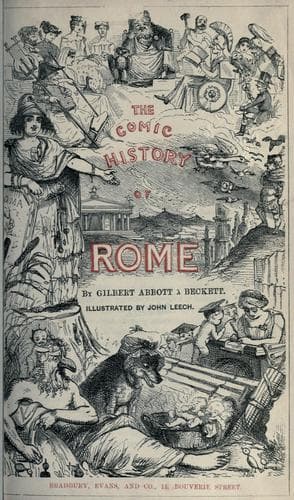
The Comic History of RomeÀ Beckett, Gilbert Abbott
History
The Comic History of Rome
À Beckett, Gilbert Abbott
Rome -- History -- Humor; Wit and humor, Pictorial
The Carthaginians, therefore, took up arms against Massinissa, who,
though ninety years of age, fought with great determination; for he
felt, probably, that he was too old to fly, and that his only chance was
to make that determined stand so well adapted to a time of life when
progress is somewhat difficult. The Carthaginians were worsted, but they
were not yet quite at their worst, until Rome was seized with the idea
of destroying their city. Cato was especially bent upon this design, or
rather he pursued it with unbending obstinacy, for he finished every
speech with the words "_Delenda est Carthago_," which may be freely
rendered into "Carthage must be smashed." Whatever might have been the
commencement of his oration, he always ended with the same words, and
whether he spoke in the Senate, the market-place, or his own house,
though the premises might be different, he always came to the same
conclusion. He went about as a man with one idea, and his conduct was
almost that of a monomaniac; for, if he met a friend in the street, and
conversed on different or indifferent subjects, he would take his
farewell with the accustomed words, "_Valete; delenda est
Carthago_,"--"Good-bye; we must smash Carthage." During a debate in the
Senate he pulled some figs out of his pocket, which he exhibited to some
of his brother members as being "remarkably fine." As the fruit was
being examined, he observed, that he had "picked them up in Africa;"
that "they were capital;" that "there were plenty more where those came
from," and, in a word, he added, "_Delenda est Carthago_"--"We really
must smash Carthage."
Rome agreed with Cato, more especially when he pointed out that the
place was exceedingly rich; for the Romans, whenever there was anything
to be got by robbery, were quite prepared for violence. The Consuls, M.
Manilius and L. Marcius Censorinus, assembled with a large force in
Sicily, where some ambassadors appeared from Carthage; but the only
result of negotiation was an order that 300 members of the best
Carthaginian families should be sent over by way of hostages. The Romans
then passed over into Utica, where the Carthaginian ambassadors again
tried to treat, but the treatment they experienced was a demand for the
instant giving up of all their arms and ammunition. Commissioners were
sent into the city to see the orders carried out, which comprised the
carrying out of 200,000 suits of armour, and 3000 catapults.[62] The
Carthaginians appear to have lost the use of their heads when they so
quietly resigned their arms; but when they were told that they must, in
the next place, abandon Carthage, and build another city ten miles off,
they began to feel--somewhat too late--that it was time to defend
themselves.
Public-domain text, read in full here on John Shaqi.
Reviews
Reviews
No reviews yet
Be the first to share your thoughts on this work.
Elsewhere in the archive
Join the Discussion
Join the discussion
Sign in to leave a comment or review.
Sign InorCreate an account