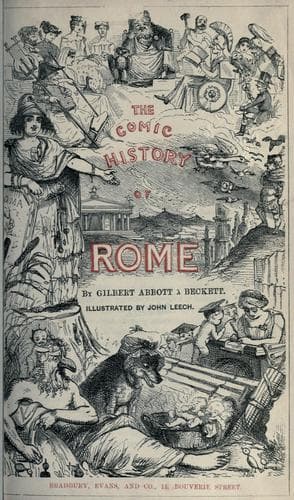
The Comic History of RomeÀ Beckett, Gilbert Abbott
History
The Comic History of Rome
À Beckett, Gilbert Abbott
Rome -- History -- Humor; Wit and humor, Pictorial
The Carthaginian ambassadors proceeded to the usual expression of
anguish by tearing their hair out by the roots, instead of trying to
pluck up a little courage. Some, who were already bald, rolled
themselves in the dust; and only a few went, like sensible men, to
communicate to the Carthaginians the doom with which their city was
threatened.
The receipt of the news seems to have deprived the Carthaginians of all
their natural intelligence; for their first step was to maltreat the
envoys. An effort was then made to save the city, by shutting the gates;
and the citizens armed themselves with stones, having determined to set
their lives upon the cast of these unwarlike missiles. It is impossible
not to respect and admire the heroism displayed under the very trying
circumstances; but, unfortunately, trying was of little use, for the
chances were all against the Carthaginians. Hasdrubal, who had been
living in exile, at the head of 20,000 men--a somewhat large party to
remain in banishment--was sent for to take the command, and occupied a
post outside the city. The inhabitants, having given up all their
ordinary arms to the enemy, supplied fresh ammunition by devoting all
their gold and silver to the furnace; and it was a melting sight to see
their treasure sacrificed for this patriotic object. The women cut off
their hair, to devote it to the making of crossbows, and the sex took a
characteristic pride in furnishing as many strings to a bow as possible.
They worked so energetically, that they are said to have fabricated as
many as 500 javelins, 140 bucklers, and 300 swords each day; but this
statement seems to involve so much of fabrication, that we find
difficulty in believing it.
The resistance of Carthage was obstinate; and the confidence of Rome led
to a sort of indolence on the part of the latter, which protracted the
siege, until a new life was put into the affair, by the appointment of
young P. C. Scipio, the son of Paulus Æmilius, to the Consulship. The
Carthaginians also were urged to fresh exertion, and a party of 300
waded through the harbour, with torches in their hands, to burn some
engines; but the water damped their efforts, which might be compared to
an attempt to set the Thames on fire; and all who were not drowned were
glad to make their way back again. The suggestion of the use of flame
was an unfortunate one for Carthage, since it seemed to cause the
breaking in of a new light upon the Romans, who had recourse to
incendiarism in their turn for the accomplishment of their object.
Having got within the walls, they ignited several houses, and, carrying
fire from street to street, they invested their cause with a glare which
is none the less hateful for having been the glare of victory.
Public-domain text, read in full here on John Shaqi.
Reviews
Reviews
No reviews yet
Be the first to share your thoughts on this work.
Elsewhere in the archive
Join the Discussion
Join the discussion
Sign in to leave a comment or review.
Sign InorCreate an account