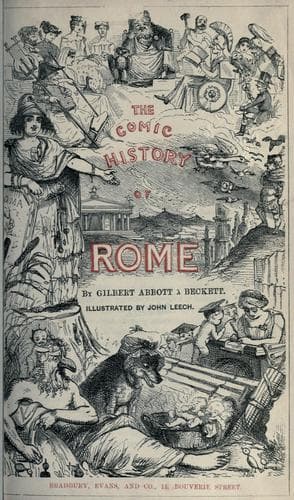
The Comic History of RomeÀ Beckett, Gilbert Abbott
History
The Comic History of Rome
À Beckett, Gilbert Abbott
Rome -- History -- Humor; Wit and humor, Pictorial
After nearly everybody had been killed, 50,000 men and women came forth
with olive branches to meet the conqueror; and 900 Roman deserters were
still stowed away in the citadel. Hasdrubal yielded; but his wife, who
was a strong-minded woman, reviled him in a speech from the ramparts,
and, parading her poor helpless children up and down for a few minutes,
she threw them before her, and ultimately flung herself into the burning
ruins. Preceding historians have expressed their admiration of this
frantic female, for the act of murder and suicide which we have
described; but we must confess our total inability to appreciate the
heroism of a piece of cruelty and cowardice, involving a large amount of
brutal daring, but wholly destitute of moral fortitude.
Carthage was now utterly destroyed, and Scipio, who had been the main
instrument of its having been set on fire, is said to have shed tears
over its smouldering ashes; but we should be inclined to attribute the
fact to the smoke having got into his eyes, rather than to any feeling
of humanity. Even those who give him credit for sensibility, accuse him
of selfishness, for they say that he alluded to the possibility that the
same fate would befal his own country; and they add that, while thinking
of his home, he quoted Homer, who had foretold the doom of Troy through
the mouth of Hector.[63] The Romans having possession of the place,
razed to the ground every part that had escaped the flames; but they
lowered themselves even still more completely than they levelled the
city. Thus fell a place which had maintained a noble rivalry with Rome,
and which, in many respects, surpassed her proud competitor.
The greatness of Carthage had been, undoubtedly, the cause of that
littleness of feeling which had been manifested towards it by Cato, who
could not bear the idea that there should exist a city rivalling in
grandeur the place he inhabited. The walls, which were triple, were
divided into two stories, the upper for men, and the lower for brutes;
the former comprising barracks for soldiers, and the latter being fitted
up as stables for elephants.
The chief glory of the place was, however, to be found in its aqueducts,
which ran in a long line of seventy miles, and of which the people had
more reason to be proud than of even a still longer line of ancestors.
That a place surrounded almost by aqueducts should have been destroyed
by fire, is an extraordinary fact, though it is possible that turncocks
may have been neglectful, and if called upon to turn the water on, they
may have turned it off in favour of some more agreeable engagement.
Public-domain text, read in full here on John Shaqi.
Reviews
Reviews
No reviews yet
Be the first to share your thoughts on this work.
Elsewhere in the archive
Join the Discussion
Join the discussion
Sign in to leave a comment or review.
Sign InorCreate an account