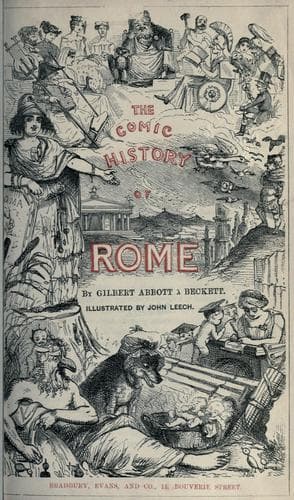
The Comic History of RomeÀ Beckett, Gilbert Abbott
History
The Comic History of Rome
À Beckett, Gilbert Abbott
Rome -- History -- Humor; Wit and humor, Pictorial
Tib. had already won some reputation in Spain, and was returning home,
when he saw the Etrurian estates of the wealthy being cultivated by
foreign slaves in chains, whose bonds not only bore the seal of
degradation for themselves, but were the means of fettering native
industry. These slaves were housed and huddled together in places called
Ergastula, which were literally workhouses, but practically, prisons.
They are said to have been built under-ground in the shape of vaults;
but, in giving this account of their construction, there has perhaps
been some misconstruction on the part of Columella, who is the chief
authority for the statement.
We must now return to Tib. Gracchus, who had, by this time, returned to
Rome, and had formed the noble resolution of remedying abuses, though he
knew that loud abuse of himself would be the inevitable consequence. He
had seen that the aristocracy had got possession of nearly all the land,
allowing the plebeians to have no share in it, except the ploughshare,
and even this was often denied them by the employment of slaves instead
of the free agricultural labourer. Tib. was learned in the law, and
recollected the existence in the books of the old statute of Licinius,
which had fallen into disuse, and the renewal of which he thought might
put new life into the plebeian body. By this law, no one was allowed to
occupy more than 500 jugera--about 330 English acres--of the land of the
state; but the state of the land exhibited a very different distribution
of the public property.
The poorer occupants of the soil had been compelled by their necessities
to sell to the richer, and Tiberius made the popular but scarcely honest
proposal, that those who had bought should give back to those who had
sold--a suggestion which was hailed by the masses as the happy
inspiration of a patriot. The idea was simple enough, and if simplicity
is an element of grandeur, the notion was so far a great one; though, as
it is based on the principle, that when a man has sold everything he
possesses, the purchaser or the possessor should hand the property back
to the original vendor, the project is not well adapted to business
purposes. The suggestion was, however, one which enabled a patriot to go
to the country with a "cry," and though the end proposed was laudable
enough, the means, which involved an interference with the means of the
wealthy, could not command the general approval. It is true that much of
the property had been unfairly obtained, and that much more was held in
illegal quantities; but some had been the subject of regular sale, and
the general confiscation proposed was but a Procrustean measure of
justice.
Public-domain text, read in full here on John Shaqi.
Reviews
Reviews
No reviews yet
Be the first to share your thoughts on this work.
Elsewhere in the archive
Join the Discussion
Join the discussion
Sign in to leave a comment or review.
Sign InorCreate an account