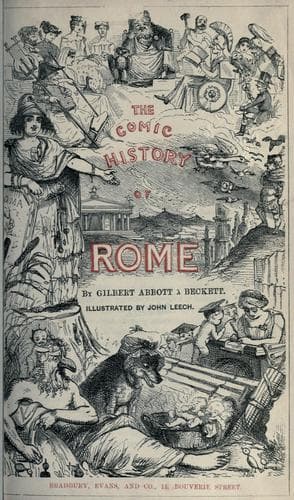
The Comic History of RomeÀ Beckett, Gilbert Abbott
History
The Comic History of Rome
À Beckett, Gilbert Abbott
Rome -- History -- Humor; Wit and humor, Pictorial
The plan was of course opposed, and the term of "selfish aristocrat" was
liberally, or illiberally--for they are unfortunately too much alike,
sometimes, in their political sense--bestowed on every one who did his
utmost to protect what the law had allowed him to regard for years as
his own property. Common sense, however, began so far to prevail over
clamour, that the proposal of Tib. Gracchus was modified to some extent,
and the distribution of the surplus land was confided to a permanent
commission of three men, who were called the Triumviri. In order to give
something like consistency to the measure, it provided, that the land
which had been taken away from its old possessors should not be sold by
the new; and thus a sort of uniformity was observed by robbing the
former, and restricting the latter; so that the principle of not being
able to do what one likes with one's own, was affirmed in each instance.
The injustice of the whole proceeding was so palpable, notwithstanding
the "popularity" of the scheme, that a compensation clause was
introduced to indemnify those who had built houses at their own expense
upon the ground; but nothing was awarded to those who had only built
upon it their hopes of being allowed to continue in quiet possession of
the property.
Party feeling ran, of course, exceedingly high, or, in other words, its
proceedings were extremely low on both sides. Tib. Gracchus was lauded
by the people as the essence of everything noble, and denounced by the
patricians as the incarnation of everything contemptible. On one side he
was hailed as a patriot, and on the other side he was hooted as a
fraudulent demagogue; so that if everything that went in at one ear went
out at the other, his head must have been a thoroughfare for every kind
of vehicle of abuse and flattery. The Senate took the meanest means of
revenge, and reduced his official salary to one denarius and a half, or
about a shilling a day in English money. Tiberius, thus curtailed of the
means on which he lived, declared there was a conspiracy against his
life, and rather prematurely went into mourning for himself, to excite
the public sympathy. Putting his children into black, he took them with
him from house to house, requesting that they might be taken in as
orphans; but the public refused to be taken in by a trick so obvious.
False accusations were, however, brought against him; and a next-door
neighbour stood up in the Senate, declaring that he had that morning
observed a diadem and a scarlet robe delivered at the back door, which
proved that Tiberius intended to usurp the regal authority. In order to
obtain the weight of an official position for his reforms, Tiberius got
himself elected tribune of the people, and the apparently inevitable
effects of taking office were at once shown in his introduction of a
modified edition of the measure he had previously clamoured for.
Public-domain text, read in full here on John Shaqi.
Reviews
Reviews
No reviews yet
Be the first to share your thoughts on this work.
Elsewhere in the archive
Join the Discussion
Join the discussion
Sign in to leave a comment or review.
Sign InorCreate an account