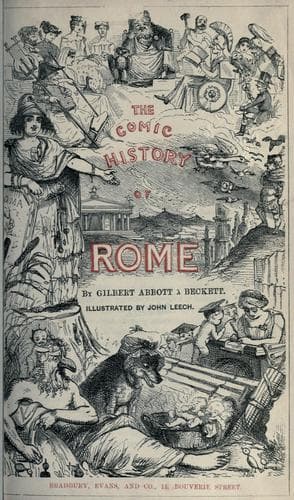
The Comic History of RomeÀ Beckett, Gilbert Abbott
History
The Comic History of Rome
À Beckett, Gilbert Abbott
Rome -- History -- Humor; Wit and humor, Pictorial
The aristocratic party set every engine and every old pump at work to
throw cold water on his project, and they at length persuaded one of his
colleagues, named Octavius, who was played upon as easily as an octave
flute, to take part against him. The mode of opposition resorted to by
Gracchus was rather more effective than constitutional, for he called
upon the people to dismiss his colleague--an arrangement almost as
equitable as it would be for one judge to insist upon the dismissal of
another, who might refuse to announce himself submissively as "of the
same opinion" with his learned brother. When, however, the people are
once fairly off, in a certain or uncertain course, they seldom think
how unfairly their precipitancy may operate. They had set their hearts
on a particular measure, and they refused to be guided by their heads;
but without deliberation, drove away every obstacle that impeded the
accomplishment of their wishes. As Octavius still held his position,
Gracchus gave notice that he had a resolution to propose, and, on the
following day, he moved the removal of his colleague. Octavius, however,
met the proposed resolution by a remarkable display of resolution on his
own part, and he declared that he should stick to his office,
notwithstanding the other's unfriendly offices. These means having
failed, Tiberius made a personal appeal to his colleague, and pointed
out to him the gracefulness of a voluntary resignation; but Octavius,
who rated himself very highly, objected altogether to the voluntary
principle. Tiberius next attempted to starve his colleague out by
sealing up the treasury; but the sealing made no impression on Octavius,
who retained his official seat until it was drawn from under him by the
mob, and he fell to the ground, between the two stools of himself and
his unscrupulous colleague. A client or creature of the Gracchi was
elected in the place of the deposed Tribune, who had been got rid of by
upsetting one of the most important forms of the constitution--that form
being no other than the bench occupied by one of the highest officers of
the government. Octavius was hurried out among the mob, who thrust him
about in every direction; but, when it came to the push, Tiberius
Gracchus endeavoured to pull him through his difficulties. The effort
was almost vain; and Octavius owed his life to a faithful slave, who
lost an eye in seeing his master through the dangers that surrounded
him. After this manifestation of the popular opinion, no Tribune
ventured to have an opinion of his own--or, if he had, he kept it to
himself, with a prudent regard to his personal safety.
Public-domain text, read in full here on John Shaqi.
Reviews
Reviews
No reviews yet
Be the first to share your thoughts on this work.
Elsewhere in the archive
Join the Discussion
Join the discussion
Sign in to leave a comment or review.
Sign InorCreate an account