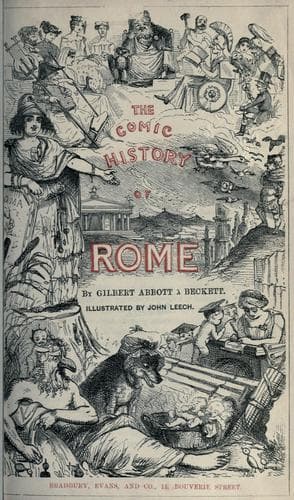
The Comic History of RomeÀ Beckett, Gilbert Abbott
History
The Comic History of Rome
À Beckett, Gilbert Abbott
Rome -- History -- Humor; Wit and humor, Pictorial
The new bill for distributing the soil became at once the law of the
land, and the two Gracchi--Tib. and Caius--with Appius Claudius, the
father-in-law of the former, became a permanent triumvirate. This desire
of the temporary holders of power to change their tenancy at will to a
life estate, has been in all ages conspicuous. The stability of
authority is so desirable, that a fixed executive seems to be everywhere
a natural want; but the mushroom might as well seek to substitute itself
for the oak, whose roots have struck deep into the soil, as the mere
chief of a revolution might hope, without any hold on the affections of
a nation, to become the founder of a dynasty.
[Illustration: Tib. Gracchus canvassing.]
Tib. Gracchus, in the true spirit of a patriot by profession, proposed
limiting every power but his own, which he sought to render as extensive
as possible. When his term of office had legally expired, he declared
that the safety of the republic required his re-election, and he
accordingly forced himself on the attention of the electors as the only
desirable candidate. On the day previous to the election, he spent all
the afternoon in the mourning he had already bought, and leading his
children by the hand, he exhibited himself and them as the "un-happy
family," in the public thoroughfares. The election had already
commenced, on the following day, when the Conservative party objected
to it on the ground of illegality. The proceedings were already opened,
when Tib. Gracchus set out on a canvass, expecting that his canvass
would enable him to reach the desired point with a wet sail and flying
colours. Not content with going alone to solicit the electors, he took
one of his own boys in his hand, and he got all the mothers on his side,
by introducing what may be termed child's play into his electioneering
movements. In the afternoon, the candidate doubted whether he would go
personally to the poll, when his friends--some of them from whom he
would have been glad to have been saved--assured him that he had better
go, for there was no danger. Taking their advice, he had got as far as
the area in front of the Capitol, when he was seized with the
irresolution of an area-sneak, and hanging about the spot, he refused to
go further. A debate was in progress among the senators, when one of
them, P. Scipio Nasica, called upon the house to come to the door, and
save the republic by sacrificing Tiberius. The whole assembly rushed
upon its legs and its crutches; some of the members seized hold of
sticks, others snatched up their clubs, and declared that the vengeance
of the clubs should fall on Tiberius. In this spirit they sallied forth,
and looking for Gracchus, they soon knocked dissension on the head, by
one of those blows which disposed of any pretensions he might have had
to a crown when they first encountered him. His brother, Caius Gracchus,
fell politically with his relative; but without resigning his office, he
Public-domain text, read in full here on John Shaqi.
Reviews
Reviews
No reviews yet
Be the first to share your thoughts on this work.
Elsewhere in the archive
Join the Discussion
Join the discussion
Sign in to leave a comment or review.
Sign InorCreate an account