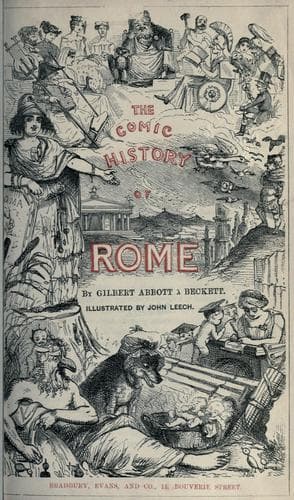
The Comic History of RomeÀ Beckett, Gilbert Abbott
History
The Comic History of Rome
À Beckett, Gilbert Abbott
Rome -- History -- Humor; Wit and humor, Pictorial
abandoned his post, and he withdrew to a little place he had in the
country, though neglecting to give up his place in the triumvirate.
[Illustration: Melancholy End of Tib. Gracchus.]
Scipio Æmilianus was on his return from Spain to Rome when he heard of
the death of his brother-in-law; and, quoting a line from Homer, to the
effect that
"All thus perish who such deeds perform,"
he declared that his relative Tib. had met with such a fate as his
antecedents warranted. Scipio at once assumed the leadership of the
Conservatives, or rather of the destructives; for their Conservatism
consisted merely in a desire to keep all they had unfairly got, while
their policy tended to break all the bonds of mutual interest and
goodwill, which can alone permanently bind society.
[Illustration: Scipio Æmilianus cramming himself for a Speech after a
hearty Supper.]
The plebeian party became quite as unreasonable on one side of the
question, as the patricians had been on the other; and C. Papirius
Carbo, a demagogue, who had got the place of tribune, proposed that the
people should have the right of re-electing the same person to the
tribuneship over and over again,--a suggestion designed to render his
own position permanent. Scipio Æmilianus opposed the measure to the
utmost; and after going home one night, he had no sooner finished his
supper, than he began to cram himself for a speech, with which he
contemplated coming out on the day following. He was, however, found
dead in his bed; and, though probability points to apoplexy as the
cause, the historians have--without much, indeed, of evidence--returned
a verdict of Wilful Murder against C. P. Carbo. We have no hesitation in
acquitting him of this dreadful crime; but we cannot say that we shall
be able to allow him to quit these pages without a stain on his
character. It is to be regretted that the Senate had not the courage to
institute an inquiry at the time when the occurrence took place, and
when only the real facts could have been ascertained; for such a course
would have saved considerable trouble to those chroniclers who are
always ready to frame an entirely new set of circumstances of their own,
to replace those which contemporaneous investigation has omitted to
supply us with.
Caius Sempronius Gracchus was getting daily more tired of his thoroughly
retired life; and, being an excellent spokesman, he began to flatter
himself that the commonweal might profit by his services. He is said to
have been urged on by his brother's ghost; but there is reason to
believe that he was impelled by a more commendable spirit. This
fraternal shade is stated to have appeared to him in his dreams; but the
matters he now began to take in hand were not those which he could
afford to go to sleep over.
Public-domain text, read in full here on John Shaqi.
Reviews
Reviews
No reviews yet
Be the first to share your thoughts on this work.
Elsewhere in the archive
Join the Discussion
Join the discussion
Sign in to leave a comment or review.
Sign InorCreate an account