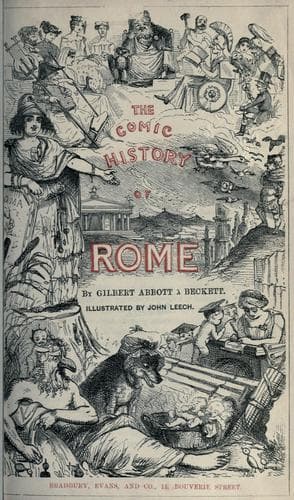
The Comic History of RomeÀ Beckett, Gilbert Abbott
History
The Comic History of Rome
À Beckett, Gilbert Abbott
Rome -- History -- Humor; Wit and humor, Pictorial
In republics, where he who is the humble servant of the people to-day,
may be, to-morrow, the people's master, talent is looked upon with
jealousy by the governing power, which, while ostensibly employing an
able instrument, may be, in fact, promoting a dangerous rival. Thus,
when the head of a nation is removable, it is reluctant to employ the
best men, lest they prove better than the head itself, and aspire to the
very highest position.
Where the form of government is monarchical, it is to the interest of
the ruler to avail himself of the ablest assistance he can obtain; for,
being himself irremovable, he becomes the fixed centre towards which the
glories and successes of his ministers and servants continually
gravitate.
It was on the principle of getting rid of a dangerous rival, that the
republican government had sent away Caius Gracchus from Rome,--where he
might have been everything--to Sardinia, where he would almost
inevitably sink to nothing. He was himself apprehensive of this result,
and he consequently returned to Rome, leaving Sardinia without the leave
of any one. His duty should have kept him abroad, but ambition urged him
home; and, in a republic, there is little to insure the fidelity of one
who, though the servant of the Government to-day, may be its master
to-morrow. Leaving the interests of his country in Sardinia to take care
of themselves, this professed patriot came to look after his own
interests in Rome, and took his talents into the political market. He
immediately stood for the tribuneship; and though he had abandoned one
post--that of Quæstor in Sardinia--he was elected to the more important
post, which might, indeed, be termed the chief pillar of popular
liberty.
Though he had, of course, solicited and obtained his high office on
purely public grounds, he at once endeavoured to use it for the
gratification of personal animosities. His first two measures were
proposed with a view to avenging his brother's death; and he sought to
give the intended new laws a retrospective effect, for the purpose of
gratifying his private enmity. He introduced a law to prevent a person
deprived by the people of any office, from being appointed to the public
service again; but this exalted patriot withdrew the bill to please his
mother. He carried various measures of more or less value, and among
them was a law for the establishment of granaries for supplying the poor
with corn at a very low price; but though this might have been very
attractive to buyers, and insured a brisk demand, it does not seem
calculated to encourage growers and sellers to such an extent that a
supply could always be relied upon. Of course, the deficiency had to be
made good from the pockets of the public; and therefore the process
amounted to little more than receiving with one hand what had been paid
by the other.
Public-domain text, read in full here on John Shaqi.
Reviews
Reviews
No reviews yet
Be the first to share your thoughts on this work.
Elsewhere in the archive
Join the Discussion
Join the discussion
Sign in to leave a comment or review.
Sign InorCreate an account