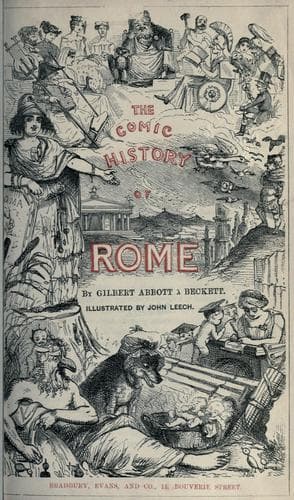
The Comic History of RomeÀ Beckett, Gilbert Abbott
History
The Comic History of Rome
À Beckett, Gilbert Abbott
Rome -- History -- Humor; Wit and humor, Pictorial
The privilege of purchasing cheap corn was not limited, as some[66] have
supposed, to the poor; but every citizen could claim his share; and even
Piso, a Consul--though perhaps he was one of the greatly reduced
Consuls--had been shabby enough to demand the privilege. Piso had been
an opponent of the law; and Gracchus, seeing him among the crowd
receiving a bushel of the cheap grain, taunted him with his
inconsistency in taking advantage of a corn measure which he had set his
face against. The answer of Piso was sensible and just; for, said he,
"though I had a strong objection to your giving away my property, I
think I have a right to try to get my share of it." Another of his
enactments vested the right of putting a Roman citizen to death, in the
people themselves, a measure that was no doubt theoretically attractive,
though practically inconvenient. To vest in the public at large the
privilege of applying the sentences to the highest offences, would
really be giving a nation so much rope, that business would be suspended
very often, instead of the criminals.
Caius Gracchus next applied himself to Law Reform with considerable
zeal; but it was not so much the law itself, as those who administered
it, that required amendment. Those who held the scales of justice, used
to weigh only the gold of the suitors; and the judges were so far
impartial, that they had no bias towards any particular side, but
favoured that which was the most liberal in bribing them. Many of the
defendants had been guilty of extortion, which was a common practice
with the judges themselves; and therefore a rude sort of honour,
commonly known as honour among thieves, was not altogether banished from
the judgment-seat. Caius Gracchus, however, caused a law to be passed,
in which we trace the origin of that glorious institution, familiarly
known as "twelve men in a box," so dear to the hearts, and sometimes,
also, to the pockets of Englishmen. The law alluded to, provided for the
trial of causes by a middle class of equites or knights, who were,
literally speaking, men who could keep a horse, and who, on the same
principle adopted in modern times as to the keepers of gigs,[67] were
considered to be respectable.
Public-domain text, read in full here on John Shaqi.
Reviews
Reviews
No reviews yet
Be the first to share your thoughts on this work.
Elsewhere in the archive
Join the Discussion
Join the discussion
Sign in to leave a comment or review.
Sign InorCreate an account