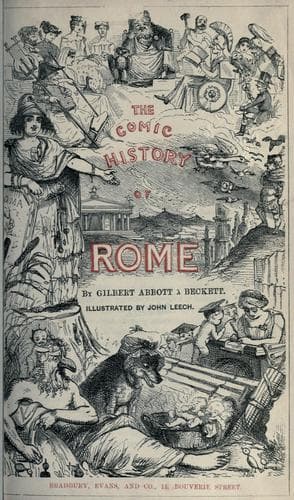
The Comic History of RomeÀ Beckett, Gilbert Abbott
History
The Comic History of Rome
À Beckett, Gilbert Abbott
Rome -- History -- Humor; Wit and humor, Pictorial
The Senators had made a practice of acquitting all criminals of their
own class, and, by acquitting themselves thus shamefully, they had
become guilty of the grossest corruption; but the equites were
frequently regardless of equity, and were found leaning with undue
leniency towards offenders of their own order. Gracchus had now become
the popular idol, but he never had an idle hour, and was always busy in
building up a reputation for himself by the construction of works of
permanent utility. He knew that general occupation is necessary to
public content, and he felt that as long as he could keep the hands of
the multitude employed on bricks and mortar, he was, in reality,
cementing his own power. This policy placed considerable patronage at
his command, and he rallied round him a crowd of contractors and
artificers, who, but for his power of giving them something better to
do, would, perhaps, have been contracting the bad habit of political
agitation, or resorting to every kind of revolutionary artifice.
The greatest political work of Caius was that in which he did the least;
and his legislative successes sink into insignificance by the side of
the real grandeur of his extensive failure. This was his attempt to
extend the franchise to all the Italians, and the other allies; but Rome
refused to aid him in the grand design, and determined to rivet upon
Italy those Italian irons with which Rome at a future period was
destined to burn her fingers. So popular was Caius Gracchus, that, upon
his re-election to office, the people, who could not get near enough to
the Campus Martius on account of the crowd, voted for him from the tops
of houses or unfinished buildings; and many came up to the poll by
climbing an adjacent scaffold.
He who would keep himself constantly sailing before the wind raised by
the breath of public applause, must be for ever on some new tack; for no
airs are more variable than those which the people are apt to give
themselves. Caius Gracchus was soon destined to discover the fact that,
amid the storms of political life, the highest point can be safely
occupied by none but the political weathercock. He had too much rigid
inflexibility to turn with every breeze; and instead of being moved by
each passing gust, he was simply dis-gusted by the vacillation
exhibited.
[Illustration: Rash Act of Caius Gracchus.]
Public-domain text, read in full here on John Shaqi.
Reviews
Reviews
No reviews yet
Be the first to share your thoughts on this work.
Elsewhere in the archive
Join the Discussion
Join the discussion
Sign in to leave a comment or review.
Sign InorCreate an account