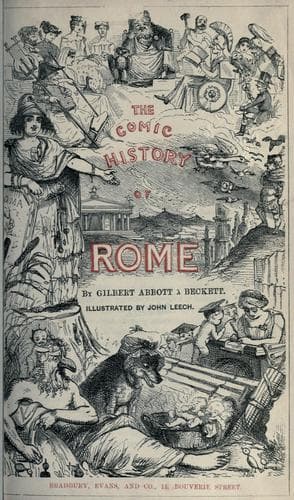
The Comic History of RomeÀ Beckett, Gilbert Abbott
History
The Comic History of Rome
À Beckett, Gilbert Abbott
Rome -- History -- Humor; Wit and humor, Pictorial
The aristocratic party, perceiving this, resolved to beat him with his
own weapons; and they prevailed upon M. Livius Drusus, his colleague in
the tribuneship, to outbid him by all sorts of extravagances for the
prize of popularity. When Gracchus proposed to distribute land among
the poor at a small fixed rental, Drusus moved, by way of amendment,
that they should have it for nothing at all; and as to the corn in the
public granaries, if Gracchus said the people ought to have it at half
price, Drusus would insist upon their right to be paid for the trouble
of walking away with it. The people, as a matter of course, followed the
man who was most profuse in his promises, rather than him who had been
the most liberal in his performances. Caius Gracchus was, in the mean
time, induced to go to Africa to mark out the ground for a new city. The
reporters of the period--who were, no doubt, in the pay of his
opponents--circulated all kinds of ill-natured stories, in which it was
alleged that the omens had been unfavourable; that the flags had been
blown down, or the pavement blown up; and that the wolves had eaten up
every flag-staff--a thing not very easy to swallow. On his return to
Rome, from which he had been absent only seventy days, he found Drusus
amazingly popular, and every nose turned up at himself, which induced
him to recognise a general snub in the faces of many of his old
followers. He offered himself a third time for the tribuneship, but he
was at the bottom of the poll, and an election row commenced, when an
officious lictor lost, first, his fasces; secondly, his securis--which
he had done his utmost to secure; and ultimately his life, in the
scuffle. Caius Gracchus, who had mainly endeavoured to keep the peace,
knew he would be accused of breaking it, and he accordingly ran as fast
as he could; but in scaling a wall to get into another street, he
unfortunately sprained his ankle. His friends continued to carry him
until, moved by a sudden instinct of self-preservation, they dropped an
acquaintance it would have been no longer safe to keep up, and poor
Caius was left alone with a single manservant. His pursuers being at his
heels, the ex-tribune desired the faithful attendant to stab him, and
the man was too much in the habit of obeying his master's orders to
hesitate. Having respectfully run his employer through, he found himself
so terribly out of place in the world, that, apologising for the
liberty, he finished himself off with the same dagger.
Public-domain text, read in full here on John Shaqi.
Reviews
Reviews
No reviews yet
Be the first to share your thoughts on this work.
Elsewhere in the archive
Join the Discussion
Join the discussion
Sign in to leave a comment or review.
Sign InorCreate an account