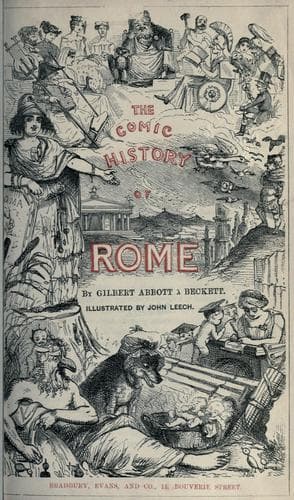
The Comic History of RomeÀ Beckett, Gilbert Abbott
History
The Comic History of Rome
À Beckett, Gilbert Abbott
Rome -- History -- Humor; Wit and humor, Pictorial
Peace had indeed been already concluded with Jugurtha; but Rome, with
its habitual want of faith, re-opened the war, which terminated at last
in Jugurtha's being taken prisoner. He was drawn behind the chariot of
Marius--a situation little less exalted than being tied to a cart's
tail, and in that position received the pelting of a pitiless storm of
mud from the congenial hands of a cowardly populace. Being thrown into a
damp dungeon, he--as we are told by the grave historians--still
preserved his wit; for he exclaimed, as he entered his prison, "By
Hercules, what a cold bath!"--a touch of humour which seems to us
remarkable for neither breadth, point, nor neatness. When, however, we
consider the moisture of the circumstances under which he was placed, we
cannot be surprised that he should have failed in an attempt at dry
humour.
The war with Jugurtha was no sooner at an end, than Rome found herself
threatened by the swords of half-a-dozen different foes; and, in default
of being able to cut herself into six, for the purpose of dividing her
strength, she seemed in danger of such a cutting-up at the hands of her
enemies. It would be a tedious task to unravel the excessive tangle into
which the threads of history are thrown by the windings of those
numerous lines of barbarians who kept themselves suspended over Rome at
about this period. The Cimbri, a Celtic race, entered into an alliance
with the Teutoni--a German band--and threw themselves upon Gaul; which
was unable to throw them off again. They encountered the Consul, M.
Junius Silanus, to whom they applied for a country to be assigned to
them; but, as this modest request could not be attended to, they set
upon Silanus, and gave him a sound beating. At length the Consul, Q.
Servilius Cœpio, offered to meet the difficulty, and approached the
Rhone, but the Cimbri cut to pieces 80,000 soldiers and 40,000 camp
followers; at least, if we are to believe the authorities, who are
always ready to mince men, though never mincing matters.
Cœpio--according to the same authentic accounts--was glad to make his
escape across the Rhone with a handful of men, and the term, "handful"
is in this instance not misapplied; for as the number is said to have
been exactly ten, he might have easily told them off on his fingers. As
if to show that they had not been actuated by mercenary motives, the
Cimbri threw into the river the whole of their booty; and, not satisfied
with spoiling the foe, they proceeded to spoil the property taken in
battle.
Public-domain text, read in full here on John Shaqi.
Reviews
Reviews
No reviews yet
Be the first to share your thoughts on this work.
Elsewhere in the archive
Join the Discussion
Join the discussion
Sign in to leave a comment or review.
Sign InorCreate an account