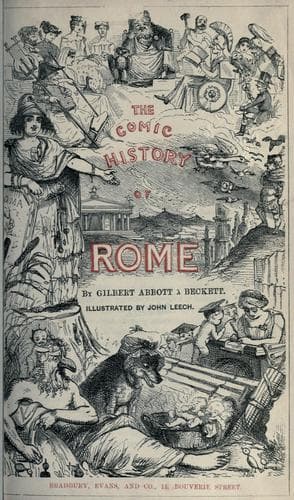
The Comic History of RomeÀ Beckett, Gilbert Abbott
History
The Comic History of Rome
À Beckett, Gilbert Abbott
Rome -- History -- Humor; Wit and humor, Pictorial
While the owner was
occupied about his hands the Roman priest took advantage of the pause to
slaughter the animal, and, on his return, the Sabine found that he had
unintentionally washed his hands of the business altogether. The oracle
was thus fulfilled in favour of the Romans, who trumpeted the fact
through the bull's horns, which were hung up in front of the temple in
memory of this successful piece of priest-craft.
The growing popularity of Servius with the plebs made the patricians
anxious to get rid of him, for they had not the sense to feel that if
they aspired to be the pillars of the state, a close union with the
class beneath, or, as they would have contemptuously termed it, the
base, was indispensable. It happened that Servius, in the hope of
propitiating the two sons of Tarquinius, had given them his two
daughters as their wives, though it was a grievous mistake to suppose
that family marriages are usually productive of family union. Jealousy
and quarrelling ensued, which ended in the elder, Tullia, persuading her
sister's husband Lucius Tarquinius to murder his own brother and his own
wife, in order that he might make a match with the lump of female
brimstone that had inflamed his brutal passions. Not satisfied with the
double murder, which would have qualified her new husband to be struck
in the hardest wax and to occupy chambers among the worst of horrors,
Tullia was always whispering into his ear that she wished her father
farther, and by this demoniac spell she worked on the weak and wicked
mind of Lucius Tarquinius. It having been reported that Servius Tullus
intended to crown his own reign by uncrowning himself, and exchanging,
as it were, the royal stock for consuls, the patricians thought it would
be a good opportunity to speculate for a fall, by attempting the king's
overthrow. Tullia and her husband were asked to join in this conspiracy,
when it was found that the wretched and corrupt pair would be quite ripe
for any enormity. It was arranged, therefore, that Lucius Tarquinius, at
a meeting of the Senate, should go down to the House with all the
insignia of royalty, and, having seated himself upon the throne, the
trumpeters in attendance were, by one vigorous blow, to proclaim him as
the sovereign. When Servius heard the news he proceeded to the Assembly,
where all things--including the trumpets--seemed to be flourishing in
favour of the traitor. As the sound of the instruments fell upon the old
king's ears, he seemed to tremble for a moment before the rude blast
which threatened the blasting of all his benevolent views, but calling
out from the doorway in which he stood, he rebuked the insolence and
treachery of his son-in-law. A disgraceful scene ensued, in which other
blows than those of the trumpeters were exchanged, and Servius, who had
in vain desired the traitor to "come off the throne," was executing a
threat to "pull him off" as well as the old man's strength, or rather,
his feebleness, would allow him.
Public-domain text, read in full here on John Shaqi.
Reviews
Reviews
No reviews yet
Be the first to share your thoughts on this work.
Join the Discussion
Join the discussion
Sign in to leave a comment or review.
Sign InorCreate an account