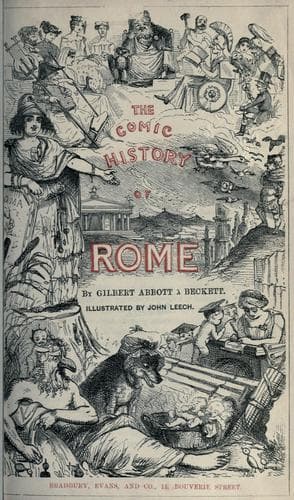
The Comic History of RomeÀ Beckett, Gilbert Abbott
History
The Comic History of Rome
À Beckett, Gilbert Abbott
Rome -- History -- Humor; Wit and humor, Pictorial
It might have been expected that Servius, when elevated above his own
humble stock, might have held his head so high and become so
stiff-necked as to prevent him from noticing the rank from which he had
sprung; but, on the contrary, he exalted himself by endeavouring to
raise others. His reign was not a continued round of fights, for he
preferred the trowel to the sword, and, instead of cutting his name with
the latter weapon, he wisely chose to build up his reputation with the
former instrument. His first care was to complete the city, to which he
added three hills, feeling, perhaps, that his fame would become as
ancient as the hills themselves; and with a happy perception that if
"walls have ears" they are just as likely to have tongues, he surrounded
Rome with a wall, which might speak to future ages of his spirit and
enterprise. He was a friend to insolvent debtors, to whom he gave the
benefit of an act of unexampled liberality. Desiring them to make out
schedules of their liabilities, he paid off the creditors in a double
sense, for they were extremely reluctant to receive the cash, the
payment of which cashiered their claim on the person and possessions of
their debtors. He abolished imprisonment for debt, giving power to
creditors over the goods and not the persons--or, as an ingenious
scholar has phrased it, the bona and not the bones--of their debtors.
[Illustration: Debtor and Creditor.--Seizure of Goods for a Debt.]
Servius found that while he was raising up buildings he was knocking
down a great deal of money; but being nevertheless anxious to erect a
temple to Diana on the Aventine Hill he persuaded the Latins, who had
made the place a sort of _quartier Latin_, to subscribe to it. The
Latins, the Romans, and the Sabines, were every year to celebrate a sort
of union sacrifice on this spot, where the cutting up and cooking of
oxen formed what may be termed a joint festival. It happened that a
Sabine agriculturist had reared a prize heifer, which caused quite an
effervescence among his neighbours, and taking the bull quietly by the
horns, he asked the augur what it would be meet for him to do with it.
The soothsayer looked at the bull, who turned his brilliant bull's eye
upon the astonished sage, with a sort of supercilious stare that almost
amounted to a glaring oversight. The augur, not liking the look of the
animal, and anxious, no doubt, to put an end to the interview, declared
that whoever sacrificed the beast to Diana, off-hand, would benefit his
race, and cause his nation to rule over the other confederates. The
animal was led away with a shambling gait to the sacred shambles, where
the Roman priest was waiting to set his hand to any Bull that might be
presented to him. Seeing the Sabine preparing to act as slaughterman,
the pontiff became tiffy, and suggested, that if the other was going to
do the job, he might as well do it with clean hands, upon which the
Sabine rushed to the river to take a finger bath.
Public-domain text, read in full here on John Shaqi.
Reviews
Reviews
No reviews yet
Be the first to share your thoughts on this work.
Join the Discussion
Join the discussion
Sign in to leave a comment or review.
Sign InorCreate an account