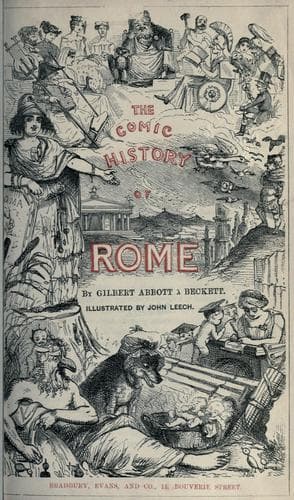
The Comic History of RomeÀ Beckett, Gilbert Abbott
History
The Comic History of Rome
À Beckett, Gilbert Abbott
Rome -- History -- Humor; Wit and humor, Pictorial
The greatest work, however, of the reign of Servius was the reform of
the Constitution, which he constructed with a view to the reconciling of
the wide differences between the patricians and the plebeians, so as to
form one powerful body by making somebodies of those who had hitherto
been treated as nobodies. His first care was to divide the plebeians
into thirty tribes--a name derived from the word _tribus_, or three, and
applied to the three plebeian tribes--the derivation being so simple
that were we to ask any schoolboy if he understood it, his answer would
be, that "he might be whipped" and he would assuredly deserve to be
whipped "if he didn't." These thirty tribes were placed under an officer
called a _tribunus_, whose duty it was to keep a list of the members and
collect the _tributum_--a word, to which in the reader's ready mind, the
word tribute will at once be attributed. Besides the orders of
patricians and plebeians, whose position was determined by descent
alone, Servius thought there were many who might be connected together
by a tie proper to them all, namely, that of property. He accordingly
established a census to be held every five years, in which the name of
every one who had come to man's estate was put down, together with the
amount of his other estate, if he was lucky enough to have any. The
whole number was divided into two heads, one of which was foot, or
_pedites_, and the other horse, or _equites_, among whom an equitable
share of rights and duties had to be distributed. The _pedites_, or
infantry, were not all on the same footing, but were subdivided into six
classes, according to the amount of their possessions, which determined
their position in the army; but even the sixth class, or those who had
no other possession than their self-possession, were not excluded from
the service. Each class was divided into seniors and juniors, the former
being men between forty-five and sixty; the latter, including all below
forty-five and above seventeen, at which early age, though frequently
not bearded themselves, they were expected to go forth and beard the
enemy. In addition to the two assemblies of the curiæ (the _comitia
curiata_) and the tribes (the _comitia tributa_), there was instituted
by Servius a great national assembly called the _comitia centuriata_,
and consisting of the whole of the centuries. Of these centuries there
were altogether one hundred and ninety-three; but, instead of every
individual member being allowed a separate vote, the suffrage was
distributed amongst classes according to their wealth or the number of
asses they possessed, a principle which the opponent of a mere property
qualification will regard as somewhat asinine. By this arrangement the
poor were practically excluded from voting at all, unless the rich were
disagreed among themselves, when the merely industrious classes, such as
the _Fabri_--the very extensive family of the Smiths and the
Public-domain text, read in full here on John Shaqi.
Reviews
Reviews
No reviews yet
Be the first to share your thoughts on this work.
Join the Discussion
Join the discussion
Sign in to leave a comment or review.
Sign InorCreate an account