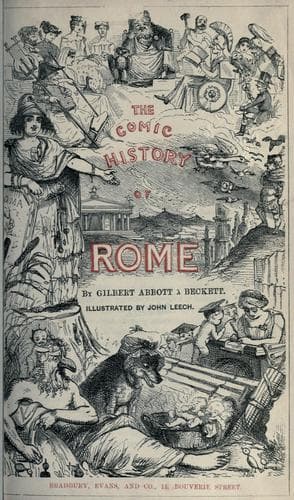
The Comic History of RomeÀ Beckett, Gilbert Abbott
History
The Comic History of Rome
À Beckett, Gilbert Abbott
Rome -- History -- Humor; Wit and humor, Pictorial
Carpenters--the _Cornicines_--the respectable race of Hornblowers--and
others of similar degree sometimes had sufficient weight to turn the
balance.
Though the equestrian centuries comprised the richest class, they seem
to have been in one respect little better than beggars on horseback, for
each eques received from the treasury a sum for the purchase of his
horse and an annual grant for its maintenance. The amount was levied
upon orphans and widows, who were, it is true, exempt from other
imposts, though their contributing from their slender means to keep a
horse on its legs caused many to complain that the law rode rough-shod
over them. The Assembly of the Centuries was a grand step towards
self-government, and, though many may think that wealth had an actual
preponderance, it was always possible for a member of a lower class to
get into a higher, and thus an inducement to self-advancement was
secured, which is, certainly, not one of the least useful ends of
government. There were numerous instances of energetic Romans rising
from century to century with a rapidity showing that they were greatly
in advance of the age, or, at all events, of the century in which they
were originally placed by their lot, or rather by their little.
Servius introduced into Rome the Etruscan As, of the value of which we
can give no nearer notion than by stating the fact that a Roman sheep
was worth about ten Etruscan asses. To the poorer classes these coins
could have been of little service, and by way of small change they were
permitted to use shells, from which we no doubt get the phrase of
"shelling out," a quaint expression sometimes used to describe the
process of paying. In some parts of the world shells are still current
as cash, and even among ourselves fish are employed at cards as the
representatives of money. Though in ordinary use for the smaller
purposes of commerce, shells were not receivable as taxes, for when the
Government required the sinews of war it would not have been satisfied
with mussels or any other similar substitute.
The Roman As was of bronze and stamped on one side with a portrait of
Janus, whose two heads we never thought much better than one, though
they appeared appropriately on a coin as a sign, perhaps, that people
are often made doublefaced by money. On the other side was the prow of a
ship, which might be emblematical of the fact that money is necessary to
keep one above water.
Public-domain text, read in full here on John Shaqi.
Reviews
Reviews
No reviews yet
Be the first to share your thoughts on this work.
Join the Discussion
Join the discussion
Sign in to leave a comment or review.
Sign InorCreate an account