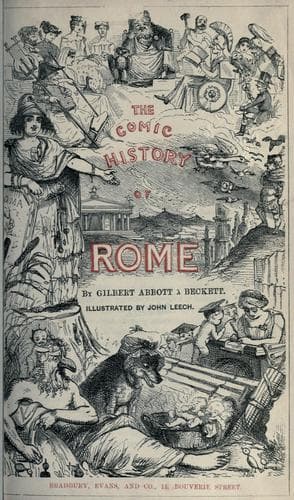
The Comic History of RomeÀ Beckett, Gilbert Abbott
History
The Comic History of Rome
À Beckett, Gilbert Abbott
Rome -- History -- Humor; Wit and humor, Pictorial
In the time of Servius all were expected to arm themselves according to
their means, and the richest were thoroughly clad in bronze for the
protection of their persons, while the poorer, who could not afford
anything of the kind, were obliged to trust for their self-defence to
their own natural metal. The patricians carried a clypeus, or shield, of
such dimensions as to cover frequently the whole body, and by hiding
himself behind it the wearer often escaped a hiding from the enemy. The
material of which the clypeus was composed was wood covered with a
bull's skin that had been so thoroughly tanned as to afford safety
against the severest leathering.
[Illustration: _Tarquinus Superbus makes himself King._]
CHAPTER THE FOURTH.
FROM THE ACCESSION OF TARQUINIUS SUPERBUS TO THE BANISHMENT OF THE ROYAL
FAMILY, AND THE ABOLITION OF THE KINGLY DIGNITY.
[Illustration]
Tarquinius had ascended the throne more by the force of his fists, than
by the strength of his arms; for he had aimed a blow, not only at the
crown, but at the face of the unhappy sovereign who had preceded him.
Carrying his hostility beyond the grave, Tarquinius refused to bury his
animosity, or to grant his victim a funeral. The upstart nature of the
new king gained for him the nickname of Superbus, or the proud, though
he had as little to be proud of as some of the most contemptible
characters in history. He, however, asserted himself with so much
audacity, that the people were completely overawed by his pretensions,
and many made away with themselves, to insure their lives, by a sort of
Irish policy, against Tarquin's violence. He took away the privileges of
the plebeians, and sent many to the scaffold, by employing them as
common bricklayers; but there were several who preferred laying violent
hands on themselves, to laying a single brick of the magnificent
buildings which he planned, in the hope, perhaps, that the splendour of
the constructions of his reign would induce posterity to place the best
construction on his character.
He coolly assumed the whole administration of the law, and added the
office of executioner to that of judge, while he combined with both the
character of a criminal, by seizing the property of all those whom he
punished, and thus adding robbery to violence. To prevent the
possibility of a majority against him in the Senate, he cut off several
of the heads of that body; and though he never condescended to submit
to the Assembly a single question, he treated the unhappy members as if
they had much to answer for.
Public-domain text, read in full here on John Shaqi.
Reviews
Reviews
No reviews yet
Be the first to share your thoughts on this work.
Join the Discussion
Join the discussion
Sign in to leave a comment or review.
Sign InorCreate an account