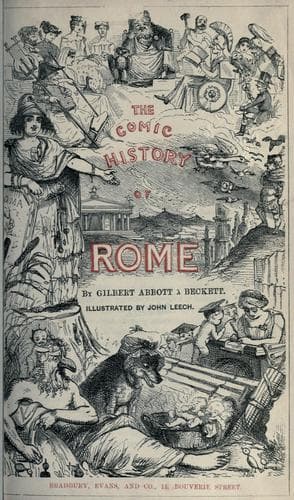
The Comic History of RomeÀ Beckett, Gilbert Abbott
History
The Comic History of Rome
À Beckett, Gilbert Abbott
Rome -- History -- Humor; Wit and humor, Pictorial
A curious anecdote, connected with the bookselling business of the
period, has been handed down to us; and it is sufficiently interesting
to be handed on to the readers of this work, who are at liberty either
to take it up, or to set it down at its real value. It is said that
Tarquin was waited upon by a female, who brought with her nine books,
and, expressing herself willing to do business, asked three hundred
pieces of gold for the entire set of volumes. The King pooh-poohed the
proposition, on the ground of the exorbitant price, and desired her to
be off with the books, when she solemnly advised him not to off with the
bargain. Finding him obstinate, the woman, who was, it seems, a sibyl,
and eked out her bookseller's profits by the business of a prophetess,
threw into the flames three of the volumes, which, assuming, for a few
minutes, the aspect of illuminated copies, soon left no traces--not even
a spark--of any genius by which they might have been inspired. The
sibyl, soon after, paid a second visit to Tarquin, bringing with her the
six remaining volumes; and having asked in vain the same sum for the
imperfect copy as she had done for the whole work, she went through a
sort of second edition of Burns, by throwing three more of her books
into the fire. To the surprise of Tarquin, she appeared a third time
with her stock of books, now reduced to three; and upon the King's
observing to her "What do you want for these?" she replied that three
hundred pieces of gold was her price; that she made no abatement; that
if the books were not instantly bought, they would speedily be converted
into light literature, and being condensed into one thick volume of
smoke, would, of course, take their final leaves of the royal residence.
The King, astonished at the woman's pertinacity, resolved at last to
send for a valuer, to look at the books, who declared them to be well
worth the money. They contained a variety of remedies for diseases,
directions for preparing sacrifices, and other interesting matter, with
a collection of the oracles of Cumæ, by way of appendix, so that the
volumes formed a sort of encyclopædia, embracing the advantages of a
Cookery Book, a Buchan's Domestic Medicine, and a Complete
Fortune-teller. Tarquin[10] became the purchaser of these three very odd
volumes, which seem to have been estimated less according to their
intrinsic value, than the price they had brought; and they were
carefully put away in the Temple library.
Public-domain text, read in full here on John Shaqi.
Reviews
Reviews
No reviews yet
Be the first to share your thoughts on this work.
Join the Discussion
Join the discussion
Sign in to leave a comment or review.
Sign InorCreate an account