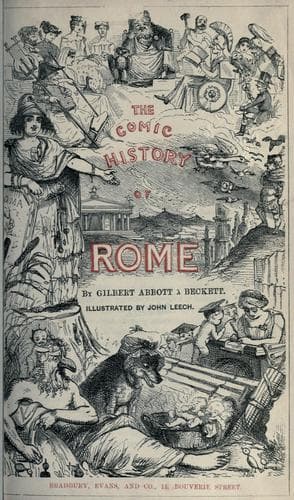
The Comic History of RomeÀ Beckett, Gilbert Abbott
History
The Comic History of Rome
À Beckett, Gilbert Abbott
Rome -- History -- Humor; Wit and humor, Pictorial
Their next call was at the house of Collatinus, whose wife, Lucretia,
was also engaged with a ball, but it was of cotton, and instead of
devoting herself to the whirl of the dance, she was spinning with her
maids, by way of spinning out the long, dreary hours of her husband's
absence. Sextus at once admitted that Collatinus had indeed got a
treasure of a wife, and the officers returned to the camp; but a few
evenings afterwards, availing himself of the introduction of her
husband, Sextus paid the lady a second visit. Being a kinsman, he was
asked to make himself at home, but his manner became so strange, that
Lucretia could not make him out; and as he did not seem disposed to go
home till morning, she retired to her chamber, with the impression, no
doubt, that being left alone in the sitting-room he would take the hint,
order his horse, and proceed to his lodgings. Lucretia was, however,
disturbed in the middle of the night by Sextus, who was standing over
her with a drawn sword, and who was guilty of such brutal insolence,
that she sent a messenger, the first thing in the morning, to fetch her
husband from Ardea, and her father from Rome, who speedily arrived with
his friend, P. Valerius, a highly respectable man, who afterwards got
the name of Publicola. Collatinus brought with him L. J. Brutus, and
Lucretia having rapidly run through the story of her wrongs, she still
more rapidly run through herself before any one had time to arrest the
deadly weapon. Revenge against Tarquin and his whole race was instantly
sworn, in a sort of quartette, by the four friends, and L. J. Brutus,
snatching up the dagger, made a great point of it in a speech he
addressed to the people in the market place. Indignation was now
thoroughly roused against the Tarquin family, and Brutus, proceeding to
Rome, called a public meeting in the Forum. He opened the business of
the day by stating what had been done, and having made his deposition he
proposed the deposition of the king; when it was moved, by way of
amendment, and carried unanimously, that the resolution should be
extended by the addition of the words, "and the banishment of his wife
and family." A volunteer corps was at once formed to set out for Ardea,
where the king was supposed to be; but on hearing of the insurrection,
he had at once decamped from the camp, and proceeded to Rome, where he
found the gates closed, and feeling himself shut out from the throne, he
took refuge with his two sons, Titus and Aruns, at Caere, in Etruria.
There history loses sight of the old king, but Sextus has been traced to
Gabii, a principality of which he thought he was the head; but the
people soon undeceived him, by showing him they would have no head at
all, for they cut him off one day in a tumult.
Public-domain text, read in full here on John Shaqi.
Reviews
Reviews
No reviews yet
Be the first to share your thoughts on this work.
Join the Discussion
Join the discussion
Sign in to leave a comment or review.
Sign InorCreate an account