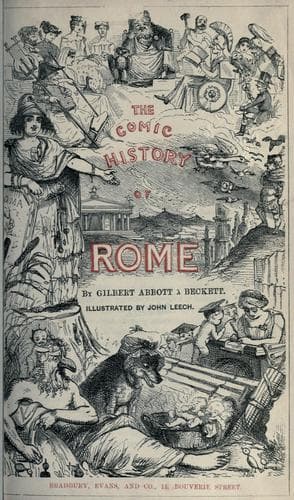
The Comic History of RomeÀ Beckett, Gilbert Abbott
History
The Comic History of Rome
À Beckett, Gilbert Abbott
Rome -- History -- Humor; Wit and humor, Pictorial
Tullia had fled, and it is not known whither; but mercy to the fallen
king would lead us to hope that the queen had gone in a different
direction from that which he had taken. The Ardeans agreed to a truce
for fifteen years--a somewhat lengthy letter of license--during which
all hostile proceedings were to be stayed, and the people decreed the
total abolition of the kingly dignity. The royal stock was converted, as
it were, into consuls, and L. Junius Brutus, with L. Tarquinius
Collatinus, were elected for one year, to fill the latter character.
Before closing an account of what is usually termed the kingly period of
the history of Rome, it is due to truth to state, that though some of
the alleged kings were good and others were bad, they must all be
considered as very doubtful characters. The fact of their existence
depends on no better authority than certain annals, compiled more than
a century and a half after the materials for compiling them had been
destroyed; and we are thus driven to rely upon the statements of certain
story-tellers, belonging, we fear, to a class, whose memories, according
to the proverb, ought to be excellent. In pretending to recollect what
they never knew, they have sometimes forgotten themselves, and in
building up their stories, they have shown how mere fabrication may
raise an ostensibly solid fabric.
Of the seven kings, who are said to have ruled in Rome during a period
of nearly two hundred and fifty years, three or four were murdered;
another subsided in a bog, and another ran for his life, which he saved
by his speed, though he was the last of the race of royalty. It is
difficult to spread these seven sovereigns over a space of two centuries
and a half, and we feel that we might as well attempt to cover an acre
of bread with a thin slice of ham, or turn the river Thames into negus
by throwing a few glasses of sherry into it. Of the earliest Roman
annals, some were burnt, leaving nothing to the student but the tinder,
from which it is, in these days, hardly possible to obtain much light,
but the greater portion of the early history of Rome has come down to us
by tradition, that extraordinary carrier, who is continually adding to
the bulk, but diminishing the weight of the matters consigned to it for
delivery.
Of the condition of the people at this early period little or nothing
can be known, and to amuse ourselves with idle guesses, would be
scarcely better than to turn into a game of blindman's buff the
important business of history. We can however state, with confidence,
that the earliest Romans had no regular coinage, but were in the habit
of answering with brass, in the rudest shape, the demands of their
creditors. Servius Tullius is reputed to have been the first who
converted the brass into coin, and marked it with the figure of a horse
or some other animal,[12] as an emblem, perhaps, of the fact, that money
runs away very rapidly.
Public-domain text, read in full here on John Shaqi.
Reviews
Reviews
No reviews yet
Be the first to share your thoughts on this work.
Join the Discussion
Join the discussion
Sign in to leave a comment or review.
Sign InorCreate an account