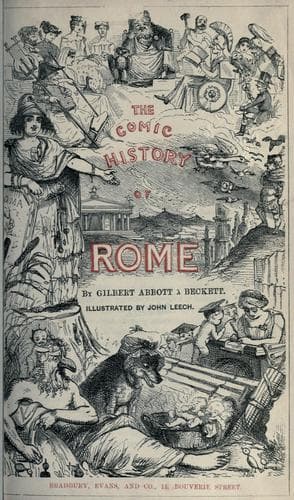
The Comic History of RomeÀ Beckett, Gilbert Abbott
History
The Comic History of Rome
À Beckett, Gilbert Abbott
Rome -- History -- Humor; Wit and humor, Pictorial
The first specimen of diplomacy to be met with in the records of Rome
must be referred to the first year of the Republic, when a treaty was
concluded with Carthage, and engraved on brazen tables. The material was
appropriate to the purpose it served; and the language was so obscure,
that a modern treaty could scarcely have surpassed it in ambiguity. Some
parts of it were unintelligible to the most learned of the Romans
themselves; and, had any difference arisen as to the interpretation of
the treaty, the tables must have been left to brazen it out; for no one
could have explained their meaning. Though the document may have
mystified many things, it made one thing clear, for it proved history to
have been wrong in stating that Horatius succeeded Brutus, for they are
described as both being consuls together at the date of the treaty. In
following the ordinary version or perversion of the facts or fictions
connected with the rise of Rome, we take history as we find it; and
though much of it is known to be false, we, by continually making the
admission, prevent the bane from remaining very long without the
antidote.
P. Valerius was still consul, with P. Lucretius for a colleague, when
the old King Tarquin happened to be on a visit, at Clusium, in Etruria,
with the local Lar, Porsenna.[13] After supper, Tarquin often grew
garrulous about his alleged wrongs, and worked on the sympathies of his
host, who declared the Romans should receive, through the medium of
Porsenna, a tremendous physicking. The Lar accordingly set forth at the
head of his army, and its approach being announced, the people in the
suburbs of Rome were frightened out of their wits, and into the city.
Throughout the whole of his journey, Porsenna administered a strong dose
to all that opposed his way; and he scoured the country by the most
drastic system of pillage. On arriving at Rome, he at once forced the
Janiculum, the garrison rushing with their leader at their head, and the
foe almost at their heels, into the city. Nothing was now between the
Romans and their assailants but the wooden bridge, or _Pons Sublicius_;
and when the people asked for consolation from their consul, he had none
to offer them. Looking at the water, he saw there was no time for
reflection; and he ordered the bridge to be cut down, when Horatius
Cocles, the gatekeeper, volunteered to offer a check to the enemy. "I
want but two," cried Horatius, "two only are wanted, to join with me in
throwing for that great stake, the safety of Rome;" and there
immediately presented themselves, as ready to "stand the hazard of the
die," if die they must, the youthful Spurius Lartius of the Neminian
race, and Herminius, belonging to the Tities. The three heroes took
their station at the foot of the bridge, resolved that no one should
pass without paying a poll-tax, in the shape of a blow on the head,
which the valiant trio stood prepared to administer. A shout of derisive
Public-domain text, read in full here on John Shaqi.
Reviews
Reviews
No reviews yet
Be the first to share your thoughts on this work.
Join the Discussion
Join the discussion
Sign in to leave a comment or review.
Sign InorCreate an account