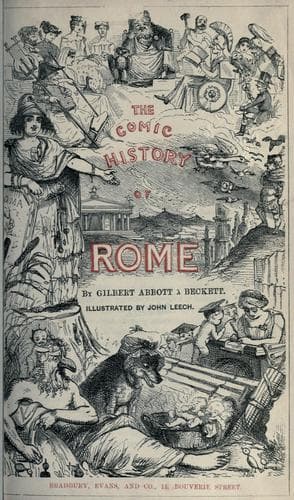
The Comic History of RomeÀ Beckett, Gilbert Abbott
History
The Comic History of Rome
À Beckett, Gilbert Abbott
Rome -- History -- Humor; Wit and humor, Pictorial
One of the oldest and most popular traditions concerning the origin of
the Romans, is that founded on the remarkable feat of filial pick-a-back
alleged to have been performed by Æneas, who is frequently dragged in
head and shoulders, with his venerable parent, to lead off the march of
events, and, as it were, open the ball of history.
It is said that after[1] the siege of Troy, Æneas snatched up his Lares
and Penates in one hand, and his father, Anchises, in the other; when,
flinging the former over the right shoulder, and the latter over the
left, he ran down to the sea-shore, called "A boat a-hoy," and escaped
from the jaws of destruction into the mouth of the Tiber. There are many
reasons for disbelieving this story, and it is quite enough to deprive
it of weight to consider what must have been the weight of Anchises
himself, and the large bundle of household images that Æneas is alleged
to have been burdened with. Putting probability in one scale, and an
elderly gentleman, with a lot of Lares and a parcel of Penates in the
other, there can be no doubt which will preponderate. It happens, also,
that Troy is usually said to have been destroyed 430 years before Rome
was founded,[2] so that it would have been to this day as unfounded as
the tale itself, if the city had had no other foundation than that which
Æneas was supposed to have given it.
The Latin Bards have adorned this story in their own peculiar way, by
adding that Æneas, on his arrival in the Tiber, resolved to sacrifice a
milk white sow, in gratitude for his safety. The sow, who must have been
an ancestor of the learned pig, got scent of her fate, and running two
or three miles up the country, produced a sad litter of thirty little
ones; when Æneas, fancying he heard a voice telling him to build a town
on the spot, determined, "please the pigs," to found a city there. The
classical story-teller goes on to say, that Latinus, king of the Latins,
happened to be at war with Turnus--or as we might call him Turner--King
of the Rutuli, when the Trojans arrived, and the former, thinking it
better worth his while to make friends than foes of the immigrants, gave
them a tract of land, which rendered them extremely tractable. On the
principle that one good turn deserves another, they turned round upon
Turnus, and completely routed the Rutuli. Latinus, to show his
gratitude, gave Lavinia--not the "lovely young" one, who Thomson tells
us, "once had friends;" but his own daughter of that name--in marriage
to Æneas, who at the death of his father-in-law, ruled over the city,
and called his colony Lavinium. Tradition tells us further that Æneas
had a son, Ascanius, sometimes called Parvus Iulus, or little Juli, who
subsequently left Lavinium, and built Alba Longa--a sort of classical
long acre--in that desirable neighbourhood known as the Alban Mount,
which, from its becoming subsequently the most fashionable part of the
city, may deserve the name of the Roman Albany.
Public-domain text, read in full here on John Shaqi.
Reviews
Reviews
No reviews yet
Be the first to share your thoughts on this work.
Join the Discussion
Join the discussion
Sign in to leave a comment or review.
Sign InorCreate an account