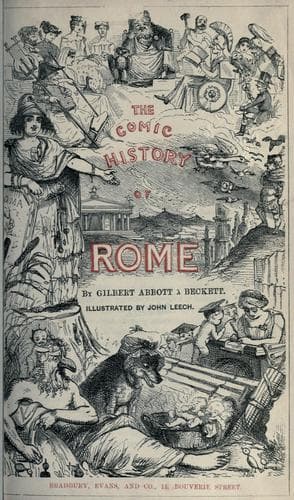
The Comic History of RomeÀ Beckett, Gilbert Abbott
History
The Comic History of Rome
À Beckett, Gilbert Abbott
Rome -- History -- Humor; Wit and humor, Pictorial
The descendants of Ascanius are said to have reigned 300 years, and an
attempt has been made to fill up the gap of these three centuries with a
quantity of dry rubbish of the antiquarian kind, which occupies space,
without affording anything like a solid foundation for the structure to
be built upon it. Of such a nature is the catalogue of matters alleged
to have connected Æneas with the actual founders of Rome; but though
names and dates are given, there is little doubt that the value of
names is not even nominal, and that if we trust the dates, we shall
rely on the falsest data.
The spirit of antiquarianism is as ancient as the subjects on which it
employs its ingenuity, and the Romans began puzzling themselves at a
very early period about their own origin. A long course of fabrication
ended in rearing up a legendary fabric, which was acknowledged by all
the Roman bards; and however much they may have doubted the truth of the
tale, they deserve some credit for the consistency with which they have
adhered to it.
The legend states that one Procas, belonging to the family of the
Silvii, or Silvers, had two sons,--the elder, to whom the kingdom was
left, being called Numitor, and the younger going by the name of
Amulius. Though Numitor was the bigger brother, he does not seem to have
been, pugilistically speaking, the better man, for he was deprived of
the kingdom by Amulius, who, to prevent the chances of the law of
primogeniture again taking effect, by placing any of Numitor's
descendants on the throne, caused Rhea Silvia, the only daughter of that
individual to become a virgin in the Temple of Vesta. The Vestals were,
in fact, the old original nuns, withdrawing themselves from the world,
and entering into a solemn vow against marriage during thirty years;
after which period they were free to wed, though they were scarcely ever
invited to avail themselves of their rather tardy privilege. The senior
sister went by the highly respectable name of Virgo Maxima--or old maid
in chief--and was doubtless something more than ordinary in her
appearance, as well as in her position. The Vestals were required to be
plain in their dress, and in order to extend this plainness as far as
possible to their looks, their hair was cut very short, however much
they may have been distressed at parting with their tresses. Their chief
duty consisted in keeping up the fire on the altar of Vesta, and they
were prohibited on pain of death from giving to any other flame the
smallest encouragement. In the event of such an offence having been
committed by an unfortunate Vestal, who found her position little better
than being buried alive, she was made to undergo literally that awful
penalty.
Public-domain text, read in full here on John Shaqi.
Reviews
Reviews
No reviews yet
Be the first to share your thoughts on this work.
Join the Discussion
Join the discussion
Sign in to leave a comment or review.
Sign InorCreate an account