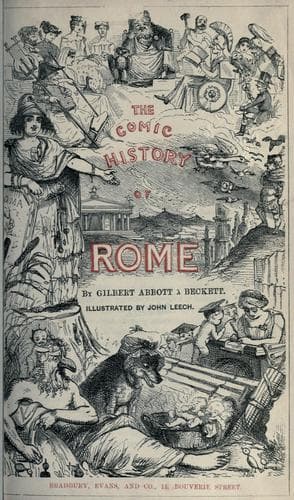
The Comic History of RomeÀ Beckett, Gilbert Abbott
History
The Comic History of Rome
À Beckett, Gilbert Abbott
Rome -- History -- Humor; Wit and humor, Pictorial
It happened that Rome was in such a perilous state as to need a strong
hand, when Cincinnatus, being famed for the use of the spade, was
invited to leave his _otium cum dig._--as everybody knows already, and
somebody may have said before--that he might assume the office of
dictator. When the messengers arrived from the senate, Cincinnatus was
at work in the fields, perhaps sowing up some old tares, or examining
the state of his pulse--a favourite crop in those days--or cutting out
the sickliest of his corn with the sickle. The soil being loamy, and
Cincinnatus being in the thick of his work, he was not very presentable;
but hastily throwing his toga round him, he made the best appearance he
could before the messengers of the senate. They at once hailed him as
dictator, and carried him to Rome, where he called out every man capable
of bearing arms; and every man thus called out, accepted the patriotic
challenge. Every soldier was to carry with him food for five days, and
twelve stakes cut into lengths to form a barricade; so that, as the
stakes weighed several pounds, and the eatables were solid, the burden
of each man, together with his accoutrements--which included a cask on
the head from which the perspiration poured--must have been
inconveniently ponderous. Notwithstanding their heavy load, the legend,
which is less weighty than their equipments, goes on to state that the
soldiers started at sunset, with Cincinnatus at their head, and reached
the camp, a distance of two-and-twenty miles, at a quick march, or
rather at a fast trot, by midnight. Though the story runs thus, we are
compelled to doubt the running of the troops, who, with their legs
encumbered by their arms and other equipments, must have found speed
impossible. On arriving at Mount Algidus, where the enemy was encamped,
Cincinnatus made his soldiers surround the place, and by aiming at all
in the ring, they were sure to hit somebody. Finding themselves in the
midst of a circle by no means social, the Æquians sued for mercy; but
Cincinnatus threw Gracchus Clœlius and his lieutenants into chains,
which was equivalent to making them enter into bonds for their future
good behaviour. Clœlius continued in his command after having been thus
formally tied down, and Cincinnatus returned to Rome in triumph. Having
held the dictatorship only sixteen days, he laid it quietly down, and
returning to his farming operations, after having submitted the enemy to
the yoke, he fitted it once more to the necks of his oxen.
Public-domain text, read in full here on John Shaqi.
Reviews
Reviews
No reviews yet
Be the first to share your thoughts on this work.
Elsewhere in the archive
Join the Discussion
Join the discussion
Sign in to leave a comment or review.
Sign InorCreate an account