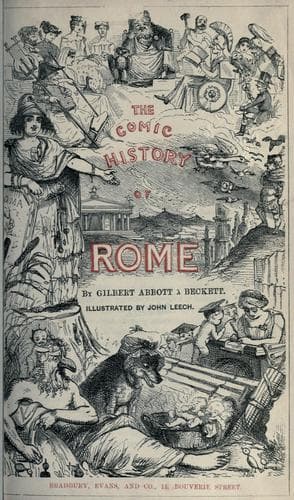
The Comic History of RomeÀ Beckett, Gilbert Abbott
History
The Comic History of Rome
À Beckett, Gilbert Abbott
Rome -- History -- Humor; Wit and humor, Pictorial
While engaged in fighting with an external enemy, a nation often forgets
the foes she has within; and it is the cruel policy of despotism to
waste the popular energy on quarrels with strangers, in order to divert
the attention of the public from domestic grievances. The war being
ended, the people began to look at home, and they soon perceived that,
while the sword of aggression had been in constant use, the sword of
justice had been rusting in the scabbard, or had been only drawn forth
to inflict, occasionally, a wound on public liberty. A movement arose in
favour of law reform, and C. Terentillus Arsa brought in a bill for
getting the patricians and plebeians to a better understanding, by
putting them on nearly the same footing. The measure led to considerable
agitation; for, though the tribunes passed it, the senate could not get
over it at all; and, the latter having thrown it out, the former brought
in a bill, containing a great deal more than the original demand, in the
year following. In political, as well as pecuniary affairs, a just claim
carries interest, which accumulates as long as the claim remains
unsatisfied; and every day, while it augments the debt due, increases
the difficulty of meeting it.
The proposition of Terentillus was much discussed in large assemblies,
the harmony of which was disturbed by some of the young patricians; for,
even in the early days of which we write, the noble art of laughing
down, or crowing over a discomfited orator, was understood by some of
the juvenile scions of aristocracy. It happened that Cincinnatus had
four sons, who were exceedingly fine young men, with very coarse
manners. One of them, named Kæso, was continually getting into street
rows, or disturbing public meetings; and frequently went so far as to
interfere with Virginius, a tribune, in the execution of his duty. The
officer was for a long time patient; but, at length, was goaded to take
the matter, as well as the offender, up; and Kæso was charged with a
series of assaults, of a more or less aggravated and aggravating
character. While these accusations were hanging over him, an old case of
manslaughter came to light; the victim having been an aged invalid, whom
Kæso, in a disreputable night brawl, had cruelly maltreated. He was
already under heavy sureties when this fresh charge was brought up, and,
to avoid meeting it, this proud patrician ran away from his bail,
leaving their recognizances to be forfeited.
Public-domain text, read in full here on John Shaqi.
Reviews
Reviews
No reviews yet
Be the first to share your thoughts on this work.
Elsewhere in the archive
Join the Discussion
Join the discussion
Sign in to leave a comment or review.
Sign InorCreate an account