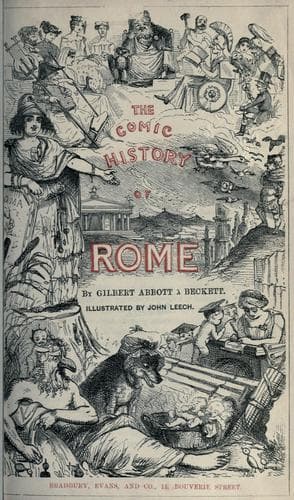
The Comic History of RomeÀ Beckett, Gilbert Abbott
History
The Comic History of Rome
À Beckett, Gilbert Abbott
Rome -- History -- Humor; Wit and humor, Pictorial
Among the incidents of the life of Camillus, a story is told of an event
that happened, when, after having subdued the Veientines, he drove the
Faliscans out their city of Falerii. There existed within the walls a
fashionable boys' school, to which the patricians sent their sons, who
were frequently taken out walking in the suburbs. One morning the
pupils, who were two and two, found themselves growing very tired one by
one, for their promenade had been prolonged unusually by the pedagogue.
The wretch and his ushers had, in fact, ushered the unsuspecting infants
into the camp of Camillus, with an intimation that the parents of the
boys were immensely opulent, that the schooling was regularly paid, and
there could be no doubt that a rich ransom could be procured for such a
choice assemblage of fathers' prides and mothers' darlings. Camillus
nobly answered, that he did not make war on young ideas not yet taught
to shoot, and he concluded by giving the schoolmaster a lesson; for,
causing him to be stripped, and putting a scourge into the hands of the
boys, the young whipper-snappers snapped many a whip on the back of
their master.
[Illustration: School-boys flogging the Schoolmaster.]
FOOTNOTES:
[18] It has been often a subject of regret that the particulars of this
expedition have not been handed down to us, and that the three Roman
excursionists did not put their heads together to form a log during
their voyage. It is, however, seldom that the marine expeditions of the
sages are fully detailed, for nothing can be scantier than the account
of the journey of the three wise men of Gotham who went to sea in a
bowl; and there is reason to believe that many a chapter has been lost
to the philosophical transactions of the world, by the chapter of
nautical accidents.
[19] "Law of the Twelve Tables," B.C. 450. "Lex Canuleia," B.C. 445.
[20] It seems, however, to have been the custom of the period for
plebeians to send their daughters from six to sixteen to a scholastic
establishment from about nine to five; and it is ten to one that
Virginia was a pupil at one of these cheap nursery grounds, in which
young ideas were planted out for the purpose of shooting.
[21]
"Then up sprung Appius Claudius, 'Stop him--alive or dead,
Ten thousand pounds of copper to the man who brings his head.'"--
_Macaulay's Lays of Ancient Rome._
[22] This description is not exaggerated, at least, if the authority of
Macaulay is to be relied upon; and for the incidents of this remote
period we are perhaps justified in trusting quite as much to the lay of
the poet, as to any other source. The following lines refer to the state
of Appius, when taken home, after the death of Virginia:--
Public-domain text, read in full here on John Shaqi.
Reviews
Reviews
No reviews yet
Be the first to share your thoughts on this work.
Elsewhere in the archive
Join the Discussion
Join the discussion
Sign in to leave a comment or review.
Sign InorCreate an account