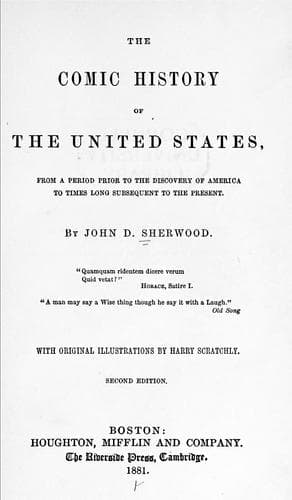
The comic history of the United States, from a period prior to the discovery of America to times long subsequent to the presentSherwood, John D.
History
The comic history of the United States, from a period prior to the discovery of America to times long subsequent to the present
Sherwood, John D.
United States -- History -- Humor
On the 1st of November, when the Stamp Act was to go into effect, most
of the bales of stamped paper, kindly sent out to emblazon colonial
writings, had either been destroyed or shipped back to their
parliamentary manufacturers. Colonial pluck went further. It agreed upon
total abstinence from everything foreign-made, until the Stamp Act
should be repealed. In 1766, after hot debate, the Stamp Act was
repealed by the British Parliament; but not before its offensive sting
was pulled out and pettishly thrown across the water in the form of a
resolution, declaring the right of the London law manufactory to tax the
Colonies whenever they wanted any money.
The old circumlocution office had neither learned how to do it, nor how
graciously or gracefully to leave off attempts which had resulted in not
doing it.
During the year following, 1767, came another bill, with a still larger
fowl behind it, a curious, sleepy-eyed, dove-colored bird, with
prehensile claws admirably sheathed when not taking hold, but very
strong when its real strength was tested.
This bill was to tax glass, paper, painters’ colors, and tea. More
colonial pluck,—more total abstinence,—more brisk talk between governors
and colonial legislatures,—more effervescing revolutions produced by
patriotic acids and alkalies stirred by newly cut sticks,—more courteous
shows of loyalty and equally firm, resolute, belligerent acts.
The colonial grievances were gathering into preparations and generating
motive-power to start the revolutionary wheel.
At Boston, in March, 1770, the first blood was shed. The ink of the
Boston “News-Letter,” which was still published, seemed to have turned
red, and was beginning to be let out. All duties were now repealed,
except those on tea. The old sting was thus again left, and the colonial
face, into which it thrust its tiny hornet spear, began to swell and
inflame.
Preparations were now made to drive back the English bees which were now
seen to come over in swarms, and to settle down around Boston and other
tender spots. Congress—that academy of celebrated American state
doctors—was called for in September, 1774, to apply poultices and such
other remedies as they deemed best to the inflamed parts. After much
consultation together, feeling the patient’s pulse and testing his
vitality, they became convinced that they had to deal with one of those
surgical cases which are quoted often afterwards as leading, and for the
successful operation in which careful preparations must be made.
The military revolutionary wheel was at length set in motion. It had
thirteen spokes, made of various kinds of wood, all unseasoned; but they
were, after a little patient effort, compactly and well fitted into the
hub. A patriotic band, put around its periphery, held the wheel
together, and enabled it to work successfully many years, and to endure
the strains and jars of colonial revolutionary wagoning.
[Illustration:
THE SURPRISE PARTY TO FORT TICONDEROGA.
(p. 247)
]
Public-domain text, read in full here on John Shaqi.
Reviews
Reviews
No reviews yet
Be the first to share your thoughts on this work.
Elsewhere in the archive
Join the Discussion
Join the discussion
Sign in to leave a comment or review.
Sign InorCreate an account