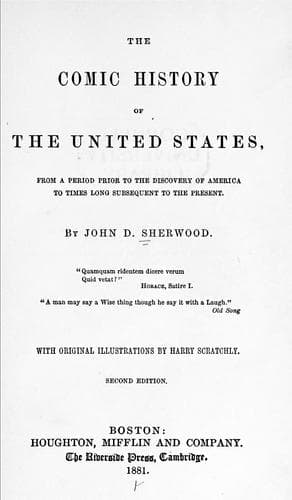
The comic history of the United States, from a period prior to the discovery of America to times long subsequent to the presentSherwood, John D.
History
The comic history of the United States, from a period prior to the discovery of America to times long subsequent to the present
Sherwood, John D.
United States -- History -- Humor
It is noteworthy that the first formal demonstration in the war, was the
despatch by the British commander, Gage, April 18, 1775, of eight
hundred men to destroy some colonial stores at Concord,—an irruption
into the very temple of peace itself. At Lexington, half-way to their
destination, this detachment was met by some seventy provincial
volunteers, who entered a bayonet protest against this breach of the
peace; but this mild protestation was answered by a sharp, crackling
retort, which was heard all through the Colonies. It was the _mot de
resistance_. The protesters retired, and the detachment, riding eight
miles further, to the Emerson-ian city, scattered the ammunition and
food there, and rode back again to Boston, being quickened on the way by
fowling-pieces and duck-guns, discharged at the red-breasted coveys. On
hearing the news of the battle of Lexington, Ethan Allen, gathering
together a party of Green Mountain boys, presented himself on the
evening of May 10, 1775, before the sleepy, dozy doors of Fort
Ticonderoga, which were knocked open, and its commandant, De La Plaine,
knocked up by a summons to surrender in the name of the great Jehovah
and the Continental Congress. The success of this little surprise party
was much talked of, and raised more spirits than the revenue acts.
Within Boston all of Gage’s forces, numbering three thousand English,
Scotch, and Irish regulars, with many hired Hessians and Waldeckers,
now retired; while twenty thousand very irregulars, farmers’ boys, and
mechanics, with John Stark in his bear-skin coat, Israel Putnam in
leather apron, and other leaders, drawn by centripetal patriotism from
their ill-supplied homes, and in such accoutrements as old family
chests yielded up, assembled in a tumultuous crowd at the American
camp, and formed a weak line around the land side of the city. While
this cord was thus stretched on the weak side of Boston,—if, indeed,
she ever had a weak side,—George Washington, then forty-three years
old, hitherto pursuing the double business of farmer and surveyor,
overlaying both ever with the cultured ease and polish of a high-bred
gentleman, already known to military men on both sides the sea by his
practical capacity in their science, evinced in Braddock’s march and
defeat, confessedly a large-headed, well-balanced, wise man, and of
intense personal courage and patriotism, was, on the 17th June, 1775,
appointed Commander-in-Chief. No statelier figure than his—over six
feet in height as it was, and cased ordinarily in large, roomy
buckskin trousers, a handsomely fitting blue coat and buff vest—was
seen at any time in the American camp for the next eight years.
Public-domain text, read in full here on John Shaqi.
Reviews
Reviews
No reviews yet
Be the first to share your thoughts on this work.
Elsewhere in the archive
Join the Discussion
Join the discussion
Sign in to leave a comment or review.
Sign InorCreate an account