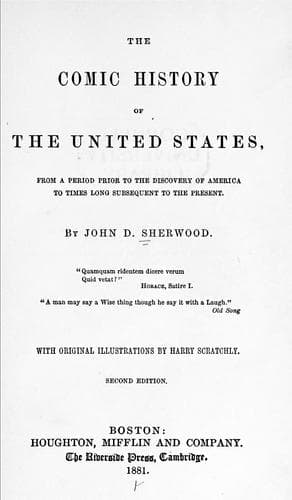
The comic history of the United States, from a period prior to the discovery of America to times long subsequent to the presentSherwood, John D.
History
The comic history of the United States, from a period prior to the discovery of America to times long subsequent to the present
Sherwood, John D.
United States -- History -- Humor
About the same time the British troops under Gage were reinforced, until
they counted twelve thousand veterans. Gage, however, did not long swing
on the military tree, or remain to be shaken from the Boston bough by
the Yankee farmers and mechanics. He was superseded by Sir William Howe,
who, in a few days after Washington’s appointment, landed at Boston,
accompanied by Sir Henry Clinton and General Burgoyne.
Believing that what cometh out of the mouth is more hurtful than what
enters it, the American army now seized Boston Neck tightly. This
contraction produced some spasms in the apoplectic-looking, newly
arrived Englishmen, who moved galvanically towards Bunker’s Hill, on the
opposite side of the city. To this point Colonel Prescott, with one
thousand men,—including some negroes,—was despatched; and here, as is
well known, he and Warren and their little party-colored regiment did
such things, June 17, 1775, to General Howe and his three thousand
attacking men, reinforced by Clinton during the day, as have been deemed
worthy of much speaking about ever since.
The brow of Bunker Hill received that day, where Warren and others fell,
a scar which not even the hard monumental patch since imposed upon it
can make us wish to forget. Higher praise of that scar we cannot
accumulate.
While these patriotic doings were going on around Boston, movements
equally patriotic were pushed forward in an entirely new
quarter,—movements, in fact, which resulted in hiring the coachman of
the Sun to drive for the future an American emigrant wagon-train, in
company with the old Western solar line. Daniel Boone, then in his
forty-fifth year, having four years before blazed a-way with his rifle
through the woods from North Carolina across the Cumberland Mountains to
the river of the same name, led out in May, 1775, a boon company,
founding a Colony on the Kentucky River, at first called Transylvania,
but which subsequently threw off, with its hunting-shirt, this long
Latinized cognomen, and stood at the dewy font to receive the dear old
name of Kentucky. The little Colony started on good wholesome
diet,—religious toleration; representatives elected by the people, from
the people, for the people; and taxation only by their own
representatives. Sheltered by its seclusion from the now daily swelling
insurrection on the Atlantic coasts, the riflemen’s settlement grew
apace, picking up its flints from the primeval rocks which propped up
the neighboring Alleghany range, but pecking them for use only upon
abundant game that hovered over its dinner-pots and sauce-pans, ready to
drop into them at proper signals.
[Illustration:
WASHINGTON REVIEWS THE TROOPS AT CAMBRIDGE.
(p. 251)
]
Public-domain text, read in full here on John Shaqi.
Reviews
Reviews
No reviews yet
Be the first to share your thoughts on this work.
Elsewhere in the archive
Join the Discussion
Join the discussion
Sign in to leave a comment or review.
Sign InorCreate an account