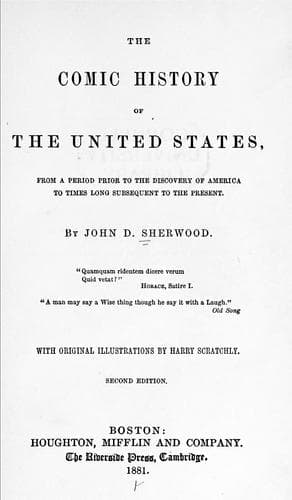
The comic history of the United States, from a period prior to the discovery of America to times long subsequent to the presentSherwood, John D.
History
The comic history of the United States, from a period prior to the discovery of America to times long subsequent to the present
Sherwood, John D.
United States -- History -- Humor
In July, 1775, Washington went on to Cambridge and took charge of the
Continental forces. These forces were, it is well known, about as
unmanageable as those at work in volcanic mountains, sometimes making an
ominous rumbling, sometimes erupting awkwardly for the peace of others
near them, and occasionally discharging themselves most inconveniently
for those whose duty it was to watch them. The hot patriotic principles,
however, of these raw, unscored militia materials helped essentially the
warm endeavors of Washington, Gates, Ward, and Lee to season them into
tough disciplined, serviceable timber, and so to support loads and
resist strains. In a few months even the most unpromising sticks were
dry enough to be piled up around Boston, and thus to burn out General
Howe.
Following the old colonial habit of casting sheep’s-eyes upon Canada
whenever the dogs of war were unkennelled, that shepherd dog, Ethan
Allen, scented game at Crown Point, on the western side of Lake
Champlain. Bounding away in long leaps, without a whine or a howl to
indicate his purpose or direction, he suddenly sprang upon the British
flocks quietly feeding there, and effectually penned and secured them.
Hardly stopping to be petted for this exploit, the brave colly tore off,
with only a small pack of eighty, to Montreal; but the British keepers
there, apprised of his approach, managed, as he came up near the folds,
to seize him, put a collar around his neck, and to send him to England,
where, however, he never would hunt with the royal pack.
General Montgomery was more fortunate; for within a month after, having
taken St. John’s and Fort Chambly, he followed the footprints of Allen,
and captured Montreal. Leaving about two hundred troops in that island
city,—now the crowning jewel in the Anglo-American stomacher,—he pushed
down the St. Lawrence, and at a point twenty miles above Quebec,
absorbing the detachment of six hundred men led by the bold, dashing,
unprincipled Arnold, he advanced upon the citadel of English America.
Here in front of Quebec, after battling the cold for four weeks, the
gallant Irishman, on the last day of 1775, amidst a storm of snow and of
pelting iron hail, led on a vigorous assault against the place where,
sixteen years before, in company with the brave Wolfe, he had gathered
the bright laurels of victory, unmixed, as was not his commander’s,—with
the gloomy cypress. Now the cypress was all that he was destined to
grasp from the grim rock which resented a second capture by the same
mortal.
Public-domain text, read in full here on John Shaqi.
Reviews
Reviews
No reviews yet
Be the first to share your thoughts on this work.
Elsewhere in the archive
Join the Discussion
Join the discussion
Sign in to leave a comment or review.
Sign InorCreate an account