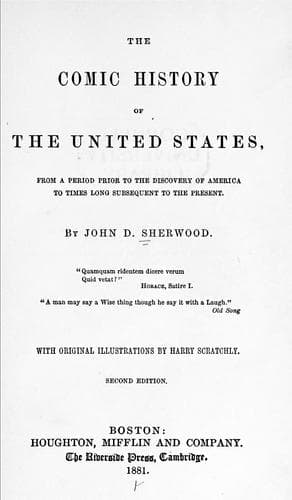
The comic history of the United States, from a period prior to the discovery of America to times long subsequent to the presentSherwood, John D.
History
The comic history of the United States, from a period prior to the discovery of America to times long subsequent to the present
Sherwood, John D.
United States -- History -- Humor
This notable group is sometimes called the Second Continental Congress.
Remarkable in looks and marked men are nearly all of the persons there
gathered,—remarkable for their average youth, as most of the members
became equally famous for great age,—remarkable, too, in a majority of
the whole number, for handsome features and intellectual presence, for
their aptitude for, and ready proficiency in, the then very mysterious
and royal business of statecraft, law-making, and army-raising,—for
their thoughtful air and high-bred bearing, and their readiness in
argument, logic, and knowledge of human rights and human nature; marked
by the heavy Hanoverian displeasure of George III., of the aristocratic
Frederic, Lord North, his minister, and of Sir William Howe, his
military generalissimo in the Colonies. Many of them, too, were marked
by heads so peculiar that the three English gentlemen just named became
very desirous of having them to put into the English State Museum, and
even went so far as to offer heavy sterling rewards for any one who
would secure them.
One of these heads immediately arrests our attention. It is very
handsome, and is set upon a fine, tall, gentlemanly figure,—both owned
by one John Hancock from Boston, only thirty-nine years of age, of large
wealth for those simple days honorably acquired by trade, of manners
conspicuously high-bred, and with a soul that, like a lamp burning
inside an alabaster vase, illuminates the beautiful characters which the
highest culture has traced and wrought. Two years ago, when Boston was
patiently biding the expected period of English justice, triumphing over
a short-sighted selfishness, and was carrying, as best she might,
meanwhile, the cruel burdens of the Boston Port Bill, and when General
Gage was sent out to see that she did not cut the straps, shift the
load, or escape its grievous weight, John Hancock,—who the evening
before had rallied with soul-lifting eloquence his fellow-sufferers at
Faneuil Hall to the unjustly imposed duty of throwing off the crushing
load,—rode at the head of his Boston Cadets, to bear with restrained
courtesy from the Long Wharf to the State House this hard plum from the
royal enclosure,—a Gage that he was careful not to pluck, but to
preserve until it was fully ripe. Among this group he sits on a raised
seat, and acts as president.
Public-domain text, read in full here on John Shaqi.
Reviews
Reviews
No reviews yet
Be the first to share your thoughts on this work.
Elsewhere in the archive
Join the Discussion
Join the discussion
Sign in to leave a comment or review.
Sign InorCreate an account