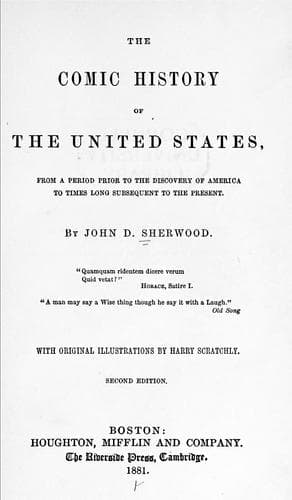
The comic history of the United States, from a period prior to the discovery of America to times long subsequent to the presentSherwood, John D.
History
The comic history of the United States, from a period prior to the discovery of America to times long subsequent to the present
Sherwood, John D.
United States -- History -- Humor
A few gentlemen, more advanced in years than the rest, are sprinkled
through the company. One, an old acquaintance of ours, the boy who in
1721 furnished through the “New England Courant” such strong food for
even Boston, and afterwards set up an intellectual bakery at
Philadelphia, now seventy years old, rests his massive benevolent figure
in a chair made comfortable by his presence,—his broad mild face, so
largely serene, framed in by flowing soft locks, and beaming with a
placid composure, as if the ploughshare of hard work had not turned a
furrow there. He looks as if he could forgive George III. for his narrow
notions, wedged inextricably fast in his narrow brain, and even his
sallow, bilious, meadow-bottomed, Hanoverian dulness, dripping in
pestilent, unhealthy oozings through his slow liver into his slower
understanding. Well does the serenely fronted old sage know all the
importance and the character of the business in hand. His clear,
philosophic mind has weighed in its calm well-adjusted balances the
questions now to be decided. He has but lately escaped from England,
where, as agent for the Colonies, he was watched and treated by the
government with incised and rigorous dislike; yet, as a man and thinker,
he was there welcomed by the best men and most advanced statesmen. With
Pitt, Camden, Burke, Charles James Fox, and even Lord North, he met, and
with calm, compact, sensible, logical eloquence discussed the nature of
the principles, alike dangerous in England as in the Colonies, which the
Ministry, in the name of the former, were seeking to fasten, as the
shirt of Nessus, upon the latter. While on his ungracious mission, he
had, also, encountered that ponderous, fact-clad, political Goliath,
Samuel Johnson, who had lately stepped forth in front of the ministerial
Philistines, and defied any one to prove that taxation of a people
unrepresented was tyranny. In that encounter, the American, armed only
with a simple Quaker sling, planted in the giant’s head a stone harder
even than itself, and very uncomfortable therein. Few now were
Franklin’s words; but each one weighed ten pounds, and though perhaps
homely in shape and unrounded at the angles, when hurled out by an
honest heart-force, they crashed resistlessly through all the fences and
thickets of sophistry or learned show.
Public-domain text, read in full here on John Shaqi.
Reviews
Reviews
No reviews yet
Be the first to share your thoughts on this work.
Elsewhere in the archive
Join the Discussion
Join the discussion
Sign in to leave a comment or review.
Sign InorCreate an account