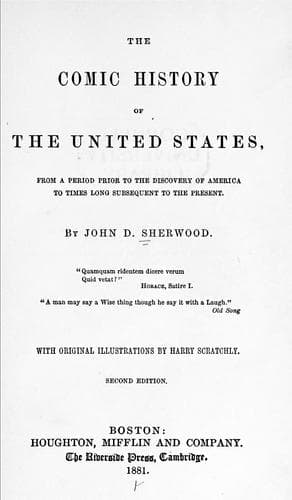
The comic history of the United States, from a period prior to the discovery of America to times long subsequent to the presentSherwood, John D.
History
The comic history of the United States, from a period prior to the discovery of America to times long subsequent to the present
Sherwood, John D.
United States -- History -- Humor
A little way off sits one of the most accomplished orators in all that
gifted group; a genial companion you may see he is at a glance. He is a
ripe scholar, educated in an English university, and yet warm with a
loving nature that glows on his face and through his graceful discourse.
Wielding a ready pen, whose vigorous strokes have already, in the
Memorial of Congress to British America, cleft the unwilling hearts of
Canadians, and, in The Address of Congress to the People of Great
Britain, have imbedded forever in the English Constitution the
principles of representation as the basis of taxation, Richard Henry
Lee, from South Carolina, three years older than Adams, sits there in
cultured ease and thoughtful dignity, a model legislator. In the
preceding month of June he had moved a resolution, asserting the rights
of the Colonies to be free, and to dissolve in brine the ligaments which
wickedly tied them to the money-making law manufactory at home. This
resolution, having of course been well debated when it came up for
consideration three days ago,—for American Congresses were never deaf or
dumb asylums,—had been adopted, and upon it a committee raised, whose
report, drawn by Jefferson, and revised by Franklin and Adams, is to be
read in to-day’s session.
A few feet away are Edward Rutledge of South Carolina, who, although
only in his twenty-third summer, is laden with the sheaves of a rich
harvest of oratorical fame; Charles Carroll of Maryland, who, annexing
to the Declaration his address, so that he might not be passed by the
state executioner for his treason, was spared by death to be the last of
that memorable party on earth; Elbridge Gerry of Massachusetts, who
lived to fill acceptably every honorable office known to our system of
government, except that of President; and Robert R. Livingston of New
York, who survived the recordership of the city of New York, and became
eminent, not only in many fields, but notably on the Hudson River, in
connection with Robert Fulton’s efforts to subject water to steam,—not
one of them, except Carroll, yet thirty-three years of age.
Leaning forward and near this last group stands the bulky figure of one
who was for the first twenty-two years of his life a shoemaker; but who,
disregarding the maxim of Horace “to stick to the last,” left the
lapstone to attend to the understandings of his suffering countrymen.
This, all know, is Roger Sherman of Connecticut, true to independence
and well-grounded freedom—to the last.
Public-domain text, read in full here on John Shaqi.
Reviews
Reviews
No reviews yet
Be the first to share your thoughts on this work.
Elsewhere in the archive
Join the Discussion
Join the discussion
Sign in to leave a comment or review.
Sign InorCreate an account