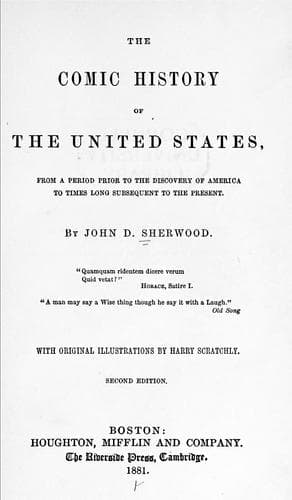
The comic history of the United States, from a period prior to the discovery of America to times long subsequent to the presentSherwood, John D.
History
The comic history of the United States, from a period prior to the discovery of America to times long subsequent to the present
Sherwood, John D.
United States -- History -- Humor
Across the room stand talking together George Wythe of Virginia,
sweet-tempered, frolicsome as a boy, yet resolute of purpose, able in
debate, and capable of deep research; Robert Morris of Pennsylvania,
born in England, an emigrant to Philadelphia in his thirteenth year,
whose nature of sterling British oak, seasoned in the counting-house of
Charles Willing, and whose solid aptitudes, hardened into financial
wisdom, were now so much needed in the new political partnership of
States; and Joseph Reed from the same State, whose sturdy, honest face
seems to light up a large space all around him, and whose rebuke two
years later to the commissioner of Lord North, who sought to bribe him,
that “poor as he was, the king of Great Britain was not rich enough to
buy him,” raised American securities as high in Europe as the practical
answers of some of his congressional successors to similar attempts on
their financial virtue by North or South, East or West, have depressed
them.
Others there are among those twoscore and eleven whom we should be glad
to delineate, as we dearly love to look at them gathered in the morning
light of that first Fourth of July; but there is such a serious,
thoughtful air, such a felt pressure weighting all brows and hearts,
that the loaded hour presses down and hushes all such light thoughts. A
prayer so simple, earnest, child-like, and trusting,—uttered amid
impressive silence by John Adams,—that it seems to bear the great
question up to the Great Heart, hushes the assembly to a balanced calm,
and opens the business.
Large sealed packages from Washington, brought on horseback all the way
from New York, are then read. They speak of his few men,—most of them
without arms, clothing, or food,—in presence of 45,000 fresh and
well-supplied English and German troops, under the command of Lord Howe,
of his brother the Admiral, and of Sir Henry Clinton. Other letters were
read from South Carolina, Georgia, Maryland, and New York, urging the
wise men to declare the old, unequal partnership with England at an
end,—a partnership to which, they felt, that the colonial partners had
furnished the capital and labor, and from which the English associates
drew all the profits.
Public-domain text, read in full here on John Shaqi.
Reviews
Reviews
No reviews yet
Be the first to share your thoughts on this work.
Elsewhere in the archive
Join the Discussion
Join the discussion
Sign in to leave a comment or review.
Sign InorCreate an account