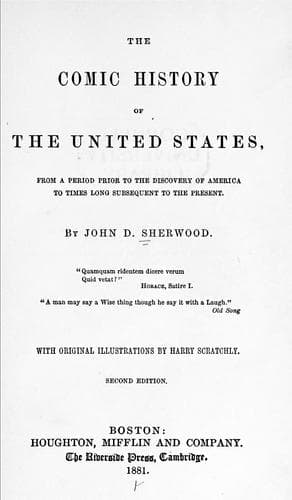
The comic history of the United States, from a period prior to the discovery of America to times long subsequent to the presentSherwood, John D.
History
The comic history of the United States, from a period prior to the discovery of America to times long subsequent to the present
Sherwood, John D.
United States -- History -- Humor
General Washington now scattered his force all along the Hudson River
from the city of New York up as high as Peekskill, his camp soups giving
off a flavor into Anthony’s nose. Some of the water used in cooking and
drinking was dipped from the Croton River. Thus early was the Croton put
into American service. At that time, we may add, the fluid was employed
to qualify and reduce the whiskey; now the whiskey is thought to be weak
enough to qualify and reduce the water. Ninety-three years have thus
united to furnish the same number of reasons as the composing elements,
contrary as they may seem to each other, for mixing the fire and water.
One may judge of the extent to which the Croton is now used from the
fact that during 1868, the amount of liquors retailed at the opening
throat of the aqueduct cost over $150,000,000. We need not add how,
during all this period, fusil-oil went down.
General Washington in November following ventured over into New Jersey,
and, like so many from the New York side since, was having a good time
at Fort Lee, when a body of Englishmen and Handeckers came down towards
them in a very rough way, and the excursionists thought it prudent to
retire, leaving their provender behind them. But for these little
surprises, war would lose some of its briskest features. Washington was
now compelled to retreat, with numbers daily diminishing, before foes
superior in numbers and constantly augmenting as they pursued. In fact,
he was obliged to bridge or ford the principal rivers or streams in
Northern New Jersey; thus furnishing the best precedent which the Camden
and Amboy Railroad engineers have ever had for carrying people across
New Jersey soil and waters in a bad temper. Newark, New Brunswick, and
Princeton fell into the hands of the enemy. Some people assert that they
are in them still.
December 8, 1776, Washington passed over the Delaware River to cover
Philadelphia, which now had much need of a lid, for it was in a terrible
stew. The country lads, as these reverses pressed upon them, took a
homesickness which nothing but their mothers and their own homes could
cure. Only about three thousand remained, shivering and tentless, and
lying near the inhospitable track of the New York and Philadelphia
Railroad. Lord Cornwallis but waited for a cold night to bridge over the
Delaware to enable him to take the Squire and his dwindling posse of
men.
Trenton was the knife-balance of American fate. Upon a nicely poised
point it swung tremblingly for a weary, anxious fortnight.
General Sullivan, having succeeded the waspish Lee, who was one night
captured at a tavern in Baskingridge by a party more spirit-ed than his
own, led, through the gloomy days of mid-December, a force of four
thousand men, provided with ammunition, across the country to
Washington. Timely indeed was the reinforcement; for Washington,
although just made by a Congressional decree supreme manager of the war,
had more need of powder than power.
Public-domain text, read in full here on John Shaqi.
Reviews
Reviews
No reviews yet
Be the first to share your thoughts on this work.
Elsewhere in the archive
Join the Discussion
Join the discussion
Sign in to leave a comment or review.
Sign InorCreate an account