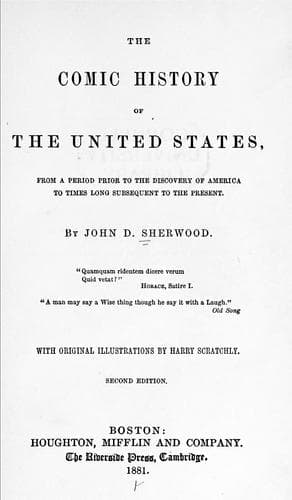
The comic history of the United States, from a period prior to the discovery of America to times long subsequent to the presentSherwood, John D.
History
The comic history of the United States, from a period prior to the discovery of America to times long subsequent to the present
Sherwood, John D.
United States -- History -- Humor
The fury of George III. at the close of the campaign of 1777 was
perfectly Hanoverian. He had been led to expect the speedy submission of
the Colonies; but he had reluctantly discovered that early disasters had
only stiffened the gristle of discontent into the bone of unconquerable
resistance. His obstinacy, however, in prosecuting the war was met by
equal firmness on the part of the Colonies in defending their rights.
If, like one of his predecessors, who, irritated by the resistance of
Scotland to his royal wishes, threatened to make that country a royal
hunting-ground, George III. threatened to make a shooting-park of North
America, the colonists, in the spirit of the Scottish nobleman who, in
reply to the menace, answered, “In that case, may it please your
Majesty, I must be home to uncouple the hounds,” were fully determined
to muzzle the royal pack, and to increase their own war-dogs.
Parliament, however, curbed by the strong arm of popular sentiment,
found it best to hold in check the royal passion and resentment. It even
slipped from the leash, not the savage bloodhounds of strife, but three
very sleek-looking house-pets, called Peace Commissioners, who came with
nice little dainty titbits in their mouths, pardons and promises, to
drop around the American door-yard.
Too late!—these royal poodles and King Charles spaniels. America had
outgrown pets, petting, and even pantalettes. She had come of age, and
deliberately made up her mind to leave the uncomfortable homestead and
to do for herself. She had a good friend in France, who encouraged her
independent notions, and who, on the 6th of February, 1778, told
everybody—England, America, and the other nations—that she was ready to
stand by the plucky Colonies. This declaration, usually termed a treaty
of alliance and commerce, was received with great joy by America, and
with keen resentment by England. Russia, always our friend from the
first, clapped France on the back for her conduct, and the people of
Europe, out of dislike to England, sided with the Colonies, and
applauded their new friend.
The old rivals, England and France, again scowled, flushed up, and
clinched.
During the rest of our Revolution French names are turned up by the
wheel, which had so far run entirely on land, side by side with
American. It was now at times to be put into water, and to dip its
blades into an element which, troubled by navigation acts, had separated
us from England, but which now, blessed by a treaty of amity, was to
unite us to the country of Lafayette.
Public-domain text, read in full here on John Shaqi.
Reviews
Reviews
No reviews yet
Be the first to share your thoughts on this work.
Elsewhere in the archive
Join the Discussion
Join the discussion
Sign in to leave a comment or review.
Sign InorCreate an account