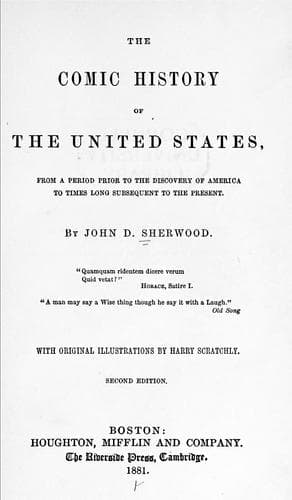
The comic history of the United States, from a period prior to the discovery of America to times long subsequent to the presentSherwood, John D.
History
The comic history of the United States, from a period prior to the discovery of America to times long subsequent to the present
Sherwood, John D.
United States -- History -- Humor
It was a hard spring in Charleston; for it hailed heavy iron hail-stones
from Sir Henry Clinton’s batteries, from April 1 to May 12, 1780; when
the city became so riddled that it gave up. The storm soon spread,
bursting over the entire States of North and South Carolina, and beating
down for a time, as with iron flails, the growing harvest of patriotism.
A good part of the crop was, however, finally saved during the late
summer, by Marion, Pickens, and Sumter, who, with their sturdy little
bands of reapers, toiled all through the blinding storms with high
spirits, and without pay. Sumter was well called “The Carolina
Game-cock”; for he often drove his sharp spurs into Corwallis and
Tarleton, and roused a very cheery feeling by his crows through those
gray mornings of liberty.
Gates, who had so successfully administered Saratoga water to Burgoyne
and his men three years before, was despatched in haste to look after
the obstinate and severe cases of Clinton, Rawdon, and Cornwallis in
South Carolina; but, as it often happens, the remedies successfully
applied to one patient often fail with another. At Camden—a name which
should have been propitious to American arms—the army of Gates was
seized by that frightful epidemic, a panic; and ran away, carrying off
with them their general’s sole chance for the next Presidency.
Nathaniel Greene, a Rhode Island Quaker,—the ungloved right hand of
Washington, who had served in the army with brilliant and yet solid
success since June, 1775,—succeeded the unsuccessful Gates in August,
1780; but the heats of summer melted out all serious campaign attempts
on either side, through the South, during that season.
St. Louis, then a village sixteen years old with nine hundred and sixty
inhabitants, exalted above the dirty Mississippi on two terraces, or a
double platform of earth, was assailed by some Englishmen and Indians
from Michilimackinac,—as it has often been since, by people of all
nations; but on this first invasion the invaders were as glad to get
away as their successors have been to stay.
Meanwhile General Greene was detailed to act as president of the court
of inquiry upon Major André, that historical romance of our war, as Mary
Queen of Scots is the sentiment of the tough annals of Scotland. This
handsome, romantic, cultivated, and high-bred Englishman, then in his
twenty-ninth year, who had unsuccessfully courted in Ireland the future
mother of Maria Edgeworth, the novelist, and then won a better fortune
from the golden hands of trade, had afterwards flung himself into the
stern arms of war. Lowering himself to the mean business of carrying
dangerous, sealed secrets in his boots, outside the mails, contrary to
all laws, and caught in the act by three militiamen, who, after playing
cards with each other, played a sharper and more patriotic game with
him, he was most disagreeably elevated to the rank of a spy, and sent in
consequence to find out the great secret on a very lonesome journey.
Public-domain text, read in full here on John Shaqi.
Reviews
Reviews
No reviews yet
Be the first to share your thoughts on this work.
Elsewhere in the archive
Join the Discussion
Join the discussion
Sign in to leave a comment or review.
Sign InorCreate an account