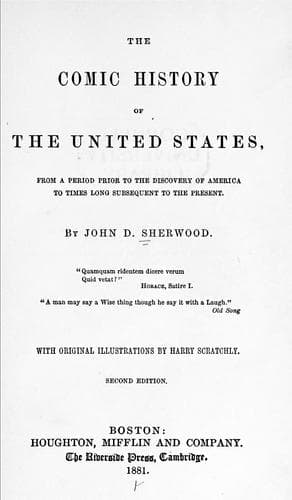
The comic history of the United States, from a period prior to the discovery of America to times long subsequent to the presentSherwood, John D.
History
The comic history of the United States, from a period prior to the discovery of America to times long subsequent to the present
Sherwood, John D.
United States -- History -- Humor
Philadelphia was made the national capital for the rest of the century;
and here, for the coming seven years, Washington’s weekly receptions on
Tuesdays, and his dinner-parties on Thursdays, created a stir among the
disciples of Penn, and caused much green-looking ink to be shed from
cavilling pens all through the country. Like congregations which look
with a keen-edged criticism upon the social movements of their
clergymen, the people thus early began to peer into the green-room of
the President’s mansion, to count the silver spoons, to feel of the
window-curtains, and to compare their silken qualities favorably with
their own hangings, and the qualities of the Presidential tenant, as
thereby affected, unfavorably with their own. A democratic people prefer
to occupy the green-room themselves.
The honeymoon of our newly wedded constitutional government was not all
roseate. Through the press a wonderful amount of good advice and
double-tongued compliment as already given to the old gentleman, who was
not likely to forget all the peccadillos he had, and to wonder why he
had been restrained from the easy commission of others which he had not
committed.
The French Revolution had now begun its series of bloody conundrums;
and, not content with posing its European circle of listeners with
perplexing questions, crossed the Atlantic, and thrust upon the
administration and demanded immediate answers to some very bothering
acrostics and puzzles. The grand riddle which they prided themselves
upon, and required to be first answered, might be stated in the
rule-of-three form thus: If France, with a population of seventeen
millions, assisted America to gain her independence from 1778 to 1783,
what aid should America, with a population of 3,927,827, give, in 1790,
to the Constituent Assembly, assuming to act for France, against the
monarchical adherents of Louis XVI. and the turbulent guillotining mob,
struggling up into fierce, resentful power under Robespierre, Danton,
and Desmoulins? This riddle was differently guessed by the leading
members of our government. Washington, Adams, Hamilton, and Jay, now
recognized as the leaders of a party for the first time called the
Federal, put in the ready, safe, and wise answer, “None”; while
Jefferson and Randolph, in the government, and Madison, Gallatin, and
young Edward Livingston, out of it,—now the heads of the anti-Federal
party,—spelled out from their general love of liberty and sympathy for
those struggling against monarchical power, without regard to
international rights or home duties, the response, “All that we can.”
Public-domain text, read in full here on John Shaqi.
Reviews
Reviews
No reviews yet
Be the first to share your thoughts on this work.
Elsewhere in the archive
Join the Discussion
Join the discussion
Sign in to leave a comment or review.
Sign InorCreate an account