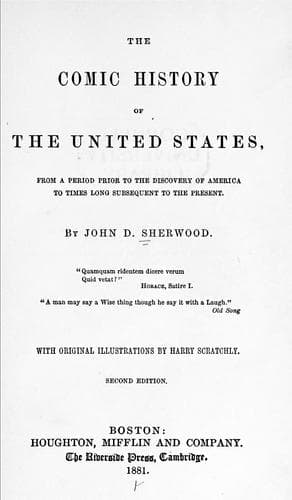
The comic history of the United States, from a period prior to the discovery of America to times long subsequent to the presentSherwood, John D.
History
The comic history of the United States, from a period prior to the discovery of America to times long subsequent to the present
Sherwood, John D.
United States -- History -- Humor
An Indian war which had broken out the preceding year within the present
limits of Ohio,—as if to remind the country of its old irritating
eruptions,—raged with some violence through 1791, reddening in spots
into a rash and producing some congestion of officers at military
head-quarters. General St. Clair, marching northwards with two thousand
men, from Fort Washington, the future Cincinnati, then consisting of a
rude stockade surrounded by a few wattled huts, and containing not
exceeding thirty white settlers, the oldest not having been there three
years, penetrated a district then obscure, but now even called Dark
County, where he was disagreeably surprised by a party of Indians, and
lost nearly three fourths of his troops. The war of course became
chronic, lingering along until 1795, when it was finally got under by
General Anthony Wayne, the old stormer of Stony Point.
Kentucky, wrought out of a small Boone settlement, in 1769, came forward
in 1792, and was welcomed as the fifteenth State. Some wavy-notioned
people imagine that her Bourbon, reinforcing her courage and spirits,
emboldened her to make this early application; but this is a mistake
which sober history is glad to correct.
Washington, although annoyed by the ganderous long-bills for his steady
adherence to the neutrality of his country between the raging factions
that were now quarrelling over the sanguinary conundrums, put forth by
the civil war in France, finally consented, against his own wishes, to
become a candidate for re-election as President. His consent was
unanimously decreed to be the popular wish by the electoral colleges.
John Adams, less fortunate than his chief, was content, however, with
seventy-seven votes out of one hundred and twenty-seven, the other fifty
being given to the Democratic candidate, George Clinton of New York.
Public-domain text, read in full here on John Shaqi.
Reviews
Reviews
No reviews yet
Be the first to share your thoughts on this work.
Elsewhere in the archive
Join the Discussion
Join the discussion
Sign in to leave a comment or review.
Sign InorCreate an account