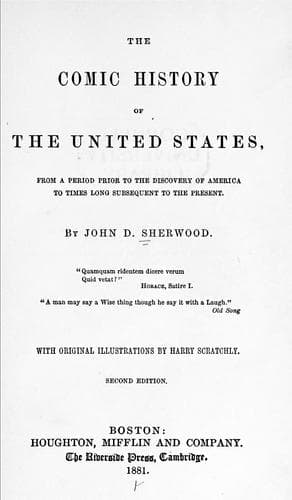
The comic history of the United States, from a period prior to the discovery of America to times long subsequent to the presentSherwood, John D.
History
The comic history of the United States, from a period prior to the discovery of America to times long subsequent to the present
Sherwood, John D.
United States -- History -- Humor
About a month after the second inauguration of Washington, in 1793, that
lively little Frenchman, Edmond Charles Genet, somewhat excited by the
revolutionary dance about the scaffold of Louis XVI., and the rather
wild scenes around the revolutionary tribunal in Paris, capered over on
a visit to the people of this country, and landed at Charleston, South
Carolina. Although commissioned by the French Convention, now the
subject of its bloody master Robespierre, as a Minister to our
government, Monsieur Genet took upon his arrival a sudden fancy to
aquatic sports, and despatched on his own hook several cruisers to fish
in the troubled waters of the Atlantic for any English, Spanish, or
Dutch flying-fish that could be caught. The old American Squire did not
at all relish this international fishing-party, which proposed to use
American lines, hooks, sinkers, and bait for the benefit of French
packers. Kindly but firmly he requested M. Genet’s forwarders to order
him back again. There have always been Americans, born with magnifying
spectacles fastened firmly on their noses, by which every form of
freedom, individual or national, spelt out to them a clear license to
help any party, fraction, or entirety of a people fighting, or claiming
to fight, against the old governing power. “Wherever you see a crown,
hit it,” is their one motto. In April, 1793, this class had many
representatives, who thought that the French gentleman and his
fishing-parties were all right.
In 1794 a Whiskey Rebellion arose, not in Kentucky nor among the
Bourbonites, but in Pennsylvania. This insurrection defied for some time
the cautionary, expostulating, and well-sealed proclamations of the
President; but when the sharp military drum-beat, backed by fifteen
thousand militia, with well-set bayonets, was heard in the western part
of the State, its leaders and their weak followers reeled back into
quiet and submission. Nothing so much shows the simplicity of that
golden age of the Republic as this resistance to a whiskey tax. In our
more debased but keener times, people distil much comfort from a heavy
tax—far heavier than that of 1794—through taps and tubes placed in the
obnoxious article, which is led off and around so circuitously and
ingeniously as hardly to know where it is going, until all of a sudden
it falls plump in large coin within the well-adjusted pockets of the
non-complaining manufacturer. Instead of getting up insurrections in
Pennsylvania against the high excise, he now forms combinations at
Washington to raise it higher.
[Illustration:
THE WHISKEY REBELLION IN 1794.
(p. 338)
]
Public-domain text, read in full here on John Shaqi.
Reviews
Reviews
No reviews yet
Be the first to share your thoughts on this work.
Elsewhere in the archive
Join the Discussion
Join the discussion
Sign in to leave a comment or review.
Sign InorCreate an account