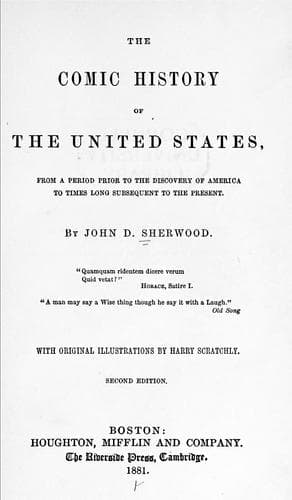
The comic history of the United States, from a period prior to the discovery of America to times long subsequent to the presentSherwood, John D.
History
The comic history of the United States, from a period prior to the discovery of America to times long subsequent to the present
Sherwood, John D.
United States -- History -- Humor
The year 1795 was the era of treaties,—establishing diplomatic lines to
England,—which ever since the peace of 1783 had been uneasily bobbing up
and down, neither fishing nor cutting bait; to Spain, whose American
possessions of Florida and Louisiana were thereby staked and roped off
from our greedy boundaries; to the dark Dey of Algiers, whose corsairs
were thus enmeshed in the silken nets; and, finally, to the Northwestern
Indian tribes, who, as usual, gave us a large piece of territory for a
little piping peace with hot embers on the top. Through the Spanish
treaty flowed, and ever since has continued to flow for us, the
wide-elbowed Mississippi. The exertion of signing it exhausted the power
of Spain in North America; for five years later she had not vitality
enough to hold either of these possessions against Napoleon, and the
orange and sugar States fell out of her ever-relaxing hand into the
clutching and restless fingers of France. In 1796, Tennessee, making the
sixteenth State, was welcomed into the household. Its capital,
Nashville, settled in 1779, contained only a few cabins; but the folds
of the Cumberland warmed them rapidly into life.
Washington, then sixty-four years of age, announced in September, 1796,
his intention to retire to the sunshine of private life. His farewell
was the blessing of a ripe sage upon a sorrowing people. It was none the
less genuine, rich, and good, because comically imitated by a few of his
successors. Even Andrew Johnson’s did not belittle it.
Several gentlemen, it was discovered, had a fancy to try the official
shades which the great American was so glad to quit. Of course Virginia
supposed that the rotation in the office should, like charity, begin at
home. Such, too, was the opinion of sixty-eight electors; but as
seventy-one disagreed with them, the short, stout, well-grained “column
of Congress” was transferred, for the four following years, into the
executive post.
CHAPTER III.
OLD FAMILY PORTRAITS.
Public-domain text, read in full here on John Shaqi.
Reviews
Reviews
No reviews yet
Be the first to share your thoughts on this work.
Elsewhere in the archive
Join the Discussion
Join the discussion
Sign in to leave a comment or review.
Sign InorCreate an account