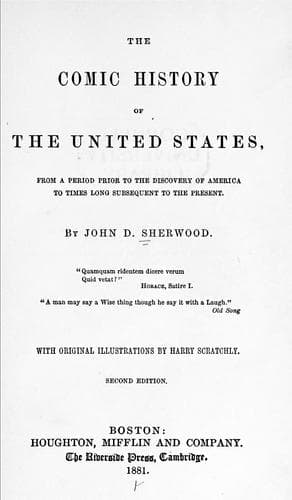
The comic history of the United States, from a period prior to the discovery of America to times long subsequent to the presentSherwood, John D.
History
The comic history of the United States, from a period prior to the discovery of America to times long subsequent to the present
Sherwood, John D.
United States -- History -- Humor
The American Cain, restless and uneasy, haunted by the pale ghost of
Hoboken, set on foot in 1806 an expedition designed either to slice off
a piece of American territory west of the Alleghanies, and to give it as
a _morceau_ to Aaron the First, to be crowned at New Orleans, his future
capital; or to rid Mexico of a part of her troublesome northern
possessions and to establish over it the dynasty of the Burrs. Tried at
Richmond, Virginia, in 1807, before Chief Justice Marshall, he had the
honor of being enclosed in the superb amber vase of Wirt’s rhetoric for
immortal preservation, but the misfortune to be dismissed on
insufficient proof to the chained companionship of the dreaded ghost.
Bonaparte, tired of his consulate for life, and anointed Emperor
December 2, 1804, by a priest whom he called from Rome to Paris for that
purpose, known as Pope Pius VII., had raised against himself and his
family pretensions the more ancient usurpers of Europe, whose equally
bold seizure of the right to govern people, and to take their money
whereon to live in ease, was veiled and historically disguised by a few
score years of unrighteous possession. Of course the ancient usurpers
despised and made faces at the newest. Armies composed of thousands of
common people—farmers, mechanics, and poor laborers—padded in
bright-colored clothes out of moneys borrowed on their credit and to be
repaid by their children, were hurled by these usurpers at each other at
Ulm, Austerlitz, and Jena; and after the smoke of the shocks rolled off,
it was found that all the crowned graspers were badly shaken up and
shattered, and had limped away exceedingly hurt in pride and limb,
excepting England only, which, mistress of the water by the victory of
Nelson at Trafalgar, in 1805, thrust her hated trident into the face of
the master of the land. The sea-tossings of the combatants became
profitable to our neutral commerce, which picked up out of the ports of
each the articles needed by the other, and laid them down on the rival
wharves. England had become too much of a trader and shopkeeper to see
such results with complacency, even if, as a belligerent, she could not
participate in the dividends. And so, in May, 1806, she attempted to
inaugurate against France—in addition to actual hostilities—a paper
blockade, by declaring, in a well-sealed and highly respectable looking
document, about two thirds of the Continent of Europe, including the
French territory and its dependencies, in a state of blockade. Without a
blockading squadron to deliver this document and to enforce the
blockade, this declaration was an empty bravado, and a fraud on the
rights of neutrals. This dog-in-the-manger device to stop the trade it
could not supply provoked the newest usurper to a like policy. Napoleon,
equally blinded by his resentments, and equally unconscientious in his
handling of international law, issued from Berlin a counter document,
Public-domain text, read in full here on John Shaqi.
Reviews
Reviews
No reviews yet
Be the first to share your thoughts on this work.
Elsewhere in the archive
Join the Discussion
Join the discussion
Sign in to leave a comment or review.
Sign InorCreate an account