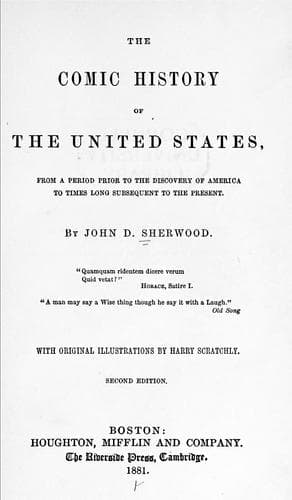
The comic history of the United States, from a period prior to the discovery of America to times long subsequent to the presentSherwood, John D.
History
The comic history of the United States, from a period prior to the discovery of America to times long subsequent to the present
Sherwood, John D.
United States -- History -- Humor
also well sealed and incapable of delivery, declaring the British Isles
in a state of blockade. Without ships—those marine constables—to serve
papers and bring offenders within maritime jurisdiction, these orders
and decrees became mischievous threats, making lawful trade piracy, and
subjecting neutral merchant vessels to arrest, detention, search, and
condemnation. England now put forth another pretension. As by the feudal
law it was held that “once a subject always a subject,” of course a
fortunate Bull remained a Bull, even when seeking work or protection on
an American vessel. American ships were thus required to stop on the
high seas and be searched for truant English stock. Such a bull England
might make of herself; but she was so angry as not to see that neutrals
would not become such silly calves as to be driven off by these
big-looking shouts.
The question was sharply stated by the Leopard, a British man-of-war, to
the Chesapeake, an American frigate, on board of which it was claimed
were four British seamen. The refusal to permit the ship’s hold to be
looked into not pleasing the Leopard, she fell unexpectedly upon the
little frigate and tore the supposed bulls with horny claws out of the
grasp of the American. The sight offended all America, especially as it
turned out that three of the four seamen were American citizens.
President Jefferson expressed the national resentment in a proclamation
interdicting all British ships entering our ports. Great Britain made
another bull by half apologizing and delivering up two of the four
seamen. The lesson of the stamp duties had not illuminated the density
of George III. He had not learned that half-apologies are confessions of
wrong, but no atonement.
Further experiments were mutually made by the two enraged fighters on
neutral rights and international decencies. In November Great Britain
forbade any one trading with France; and France, equally enterprising,
ordered the stoppage of all trade with England. Our government replied
to these illegal proceedings by an embargo on all vessels in our ports,
foreign and domestic. From December, 1807, until March, 1809, marine
beaux were abundant, and young ladies joyous. When the embargo was
raised the hopes of the latter sank. They became more desponding still
when the government forbade all commercial correspondence with France
and England.
CHAPTER VII.
THE UNITED STATES AT SEA; OR, MADISON’S CRUISE.
1809–1817.
Public-domain text, read in full here on John Shaqi.
Reviews
Reviews
No reviews yet
Be the first to share your thoughts on this work.
Elsewhere in the archive
Join the Discussion
Join the discussion
Sign in to leave a comment or review.
Sign InorCreate an account