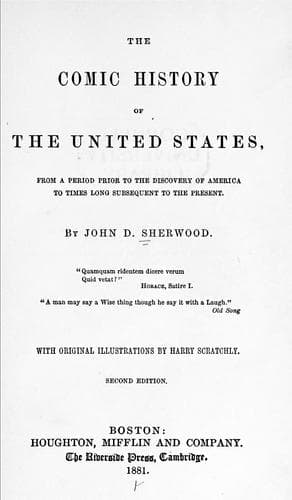
The comic history of the United States, from a period prior to the discovery of America to times long subsequent to the presentSherwood, John D.
History
The comic history of the United States, from a period prior to the discovery of America to times long subsequent to the present
Sherwood, John D.
United States -- History -- Humor
The Captain and Officers of the “Seventeen Sisters” which put to Sea in
a Gale.—Diplomatic Talks.—Difference between one’s own Cows gored, and
one’s own Bull in a Neighbor’s Field stoned, exemplified.—Cave
canem.—Bonaparte improves the Code Napoleon.—Executions before
Trials.—Horace Greeley fights benevolently into the World.—Louisiana
and her Vivacious Debts taken in; what sweetened them.—Witch-Hazel
Rods of Clay, Cheves, etc., dip to the National Mines of Feeling.—Our
Second Wrestling-Match with England.—The Hull-sale Surrender
of Michigan.—Colonel Cass breaks his Sword, and gets an
Anglo-phobia.—Better Hulls on the Water.—America marries the Sea.—A
Wasp on a Frolic.—Marine Flirtations and Engagements.—The
Constitution, an Old Sea-Flirt; her rapid Winning and Wooing of the
Java.—South Carolina loses a Presidential Candidate.—Of the Three
Armies afield.—Harrison at Tippecanoe and the Thames.—Colonel R. M.
Johnson’s life-long Chase for Tecumseh’s Scalp.—Toronto emptied and
filled.—General Brown, a Real Man, in Spite of his Name.—General Wade
Hampton.—Court-Martials, and how they touch off Military Charges.—The
United States at Sea on Land.—The Hornet on a Peacock.—An Immortal
Word wrung from a Mortal Moment.—Commodore Perry.—General Scott
improves the Niagara Frontier for Hack-Drivers.—Macdonough charges
Lake Champlain with Heroic Ingredients.—English Marine Parades.—Cotton
Breastworks at New Orleans.—Their Feminine Adoption.—The Treaty of
Peace and its Wonderful Omissions.—Costs and Gains of the War.—The
Hartford Convention and its Equestrian Exploits.—Mr. Calhoun and
Invisible Ink.
James Madison, who for eight years past had been first mate on our
national craft, was in 1809 promoted by its owners, the people, to be
Captain,—Mr. C. C. Pinckney, of South Carolina, receiving a
complimentary vote, as a Palmetto fillup. The captain’s principal
officers were: first mate, or Secretary of State, Robert Smith; second
mate, or Secretary of War, William Eustis; purser, or Secretary of the
Treasury, Albert Gallatin; boatswain, or Secretary of the Navy, Paul
Hamilton; and Cæsar A. Rodney, piper, or Attorney-General. Much need was
there of a judicious set of officers on the quarter-deck, as well as of
a good crew in the forecastle; for the Seventeen Sisters were about to
put to sea, with high storms blowing off and on the coast.
Public-domain text, read in full here on John Shaqi.
Reviews
Reviews
No reviews yet
Be the first to share your thoughts on this work.
Elsewhere in the archive
Join the Discussion
Join the discussion
Sign in to leave a comment or review.
Sign InorCreate an account