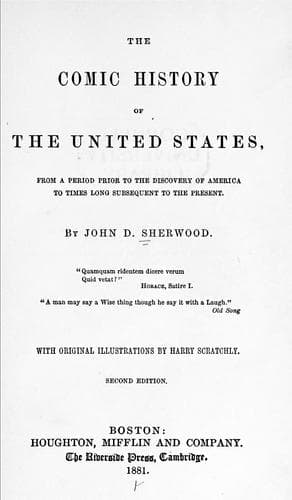
The comic history of the United States, from a period prior to the discovery of America to times long subsequent to the presentSherwood, John D.
History
The comic history of the United States, from a period prior to the discovery of America to times long subsequent to the present
Sherwood, John D.
United States -- History -- Humor
Much talk was there, as soon as Mr. Madison entered upon his duties,
between British envoys, Mr. Erskine first and Mr. Jackson afterwards, on
the one side, and our Mr. Smith on the other, about our Non-intercourse
Act. Of course the Britons did not like to have their own commercial
cows gored by our bulls; although they had enjoyed immensely the sight
of their own unmuzzled Durhams pushing wildly among our young cattle.
The British government—or, rather, their accredited agent, Mr.
Erskine—promised to repeal the obnoxious orders in council. Taking the
principals at their agent’s word, our government good-naturedly
proclaimed the renewal of commercial intercourse with England.
Thereupon, George III.—now entering the fiftieth year of king-craft,
without any improvement of his crass German notions by a cross with
British principles of shop-keeping—repudiated the acts of his agent. The
friendly hand we had offered we now took back, giving a perceptible
contraction to its muscles as we drew it in. For three years we pocketed
our fists and indignities.
In 1809 England had stationed cruisers off our coast to seize our
merchantmen, and send them in as prizes to her ports. Every American
ship-owner saw mosaicked at the outlet of every American harbor the
warning, _cave canem_, without being at liberty to stone the dog which
flew at him. Bonaparte, blood red with Spanish and Portuguese victories,
turning in cold, dynastic selfishness from the heart-faithful but
childless Josephine, and drawing to her place the reluctant,
refrigerating Maria Louise, undismayed by the fear of our junction with
the fifth coalition formed against him by England, Austria, Spain, and
Portugal, imitated for a time the swaggering injustice of England
towards us. In March, 1810, improving upon the Code Napoleon, by
execution before suit, he decreed the seizure and summary condemnation
of all American vessels entering French ports. This boyish, pouting, and
self-extinguishing policy he gave up in November following. England was
left alone in keeping unneighborly mastiffs.
Meanwhile, in the midst of the effervescence of national sediment thus
foaming up in yeasty ebullition, Horace Greeley, February 3, 1811,
fought into life. Ever since that successful contest, the world has
advanced with quickened forces. Benevolence felt reinforced by combative
intellect, which borrowed the club of logic and strong adjectives to
persuade error to keep the ways of tribunitial thought. Soon after Mr.
Greeley’s birth, Mr. Smith gave up the State Department to James Monroe,
who, for the three years following, found ample employment for his
executive abilities, in the double duties of this branch added to those
of the War bureau.
Public-domain text, read in full here on John Shaqi.
Reviews
Reviews
No reviews yet
Be the first to share your thoughts on this work.
Elsewhere in the archive
Join the Discussion
Join the discussion
Sign in to leave a comment or review.
Sign InorCreate an account